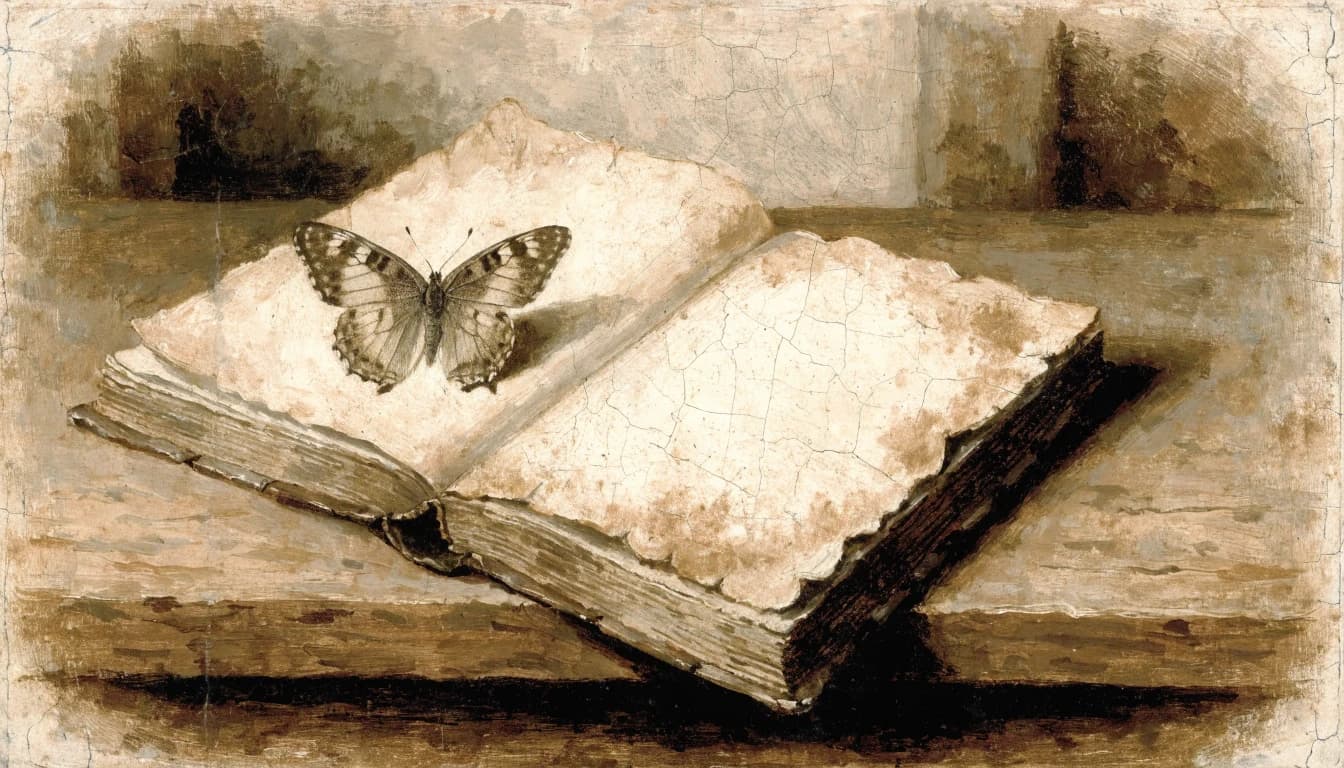
Zhuangzi woke from a dream and found himself uncertain. He had been a butterfly, fluttering without purpose or worry, with no memory of the man called Zhuangzi. Then the butterfly stopped being a butterfly, and the man called Zhuangzi sat up in his bed and wondered which of them was real. A man dreaming of a butterfly, or a butterfly dreaming of a man?
He did not try to answer the question. That was the point.
We have a natural hunger for certainty. We want to know what we are, where we stand, what is right and what is wrong. Laozi had already written the Dao De Jing, a book that whispered about a Way that could not be named, about acting without forcing, about returning to the root of things. But Zhuangzi took those ideas and made them stranger. He made them funny. He made them alive.
His book, the Zhuangzi, does not read like a philosophy treatise. It reads like someone sitting beside you on a riverbank, telling stories about giant fish that turn into giant birds, about crippled men who escape conscription because nobody wants them, about trees so knotted and twisted that the woodcutters leave them alone. These are not parables with clear morals. They are cracks in the wall of how we see things.
The Limits of a Viewpoint
You stand on a hill and see the valley below. The river bends left, the paddy fields spread out in rectangles, the village sits in the curve of the mountain. But what you see depends on where you stand. Move to the other hill, and the river bends right. The village disappears behind the ridge. What you thought was real was only real from here.
We still talk this way today: about objective reality, about hard facts, about what is true and what is false. But Zhuangzi suggests that every distinction we make, right and wrong, life and death, self and other, is a product of where we happen to be standing, a shape drawn by the Dao rather than fixed in the world itself. When we insist that the world match our categories, we stop being able to move. We get stuck.
Wu wei is not about doing nothing. It is about not forcing. It is about letting the river flow through you rather than trying to redirect it with your bare hands. The sage does not stop making choices. He stops believing that his choices are the only correct ones.
The Turtle in the Mud
A king once offered Zhuangzi the highest office in the land. Prime minister. Power over every person in the kingdom. Zhuangzi looked at the messenger and told him a story about a sacred turtle.
A turtle shell, he said, has been kept for three thousand years in a temple. Wrapped in silk. Placed in a jeweled box. Worshipped by priests. Would the turtle rather be that (dead and honored) or alive, dragging its tail through the mud?
The messenger understood. He left without another word.
This is not a rejection of ambition for its own sake. It is a rejection of the idea that one kind of life is better than another kind of life. The turtle in the mud is not glorious. It is not honored. But it is alive in its own way, on its own terms. The way of wu wei means living the life that fits you, not the life that impresses others.
The Dream That Won't End
Think back to the butterfly dream. The most unsettling part is not that Zhuangzi was uncertain. It is that he did not resolve the uncertainty. He did not decide, once and for all, that he was a man. He sat in the question and let it stay open.
Because what if he is still dreaming? What if you are still dreaming? What if the categories we build (man and butterfly, waking and sleep, life and death) are just the furniture of a dream we have not yet woken from?
The ancient Chinese did not think of death as an end. They thought of it as a transformation, like winter turning to spring, like a butterfly emerging from a cocoon. The self is not a fixed thing. It is a process, a flow, a folding and unfolding.
Zhuangzi did not write instructions for how to live. He did not give commandments or rules. He carved a crooked tree into a chair and invited you to sit in it and feel how comfortable a crooked shape can be. He dreamed he was a butterfly and woke not knowing who he was, and that sense of not knowing became freedom.