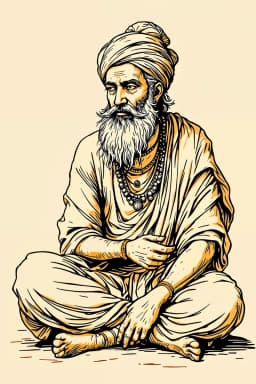
Jaimini
He built a whole philosophy around action and the authority of the word, asking what it means for a duty to bind.
Jaimini founded Mimamsa, the school devoted to interpreting the ritual and ethical commands of the Vedas. Its concern looks narrow and turns out to be deep: what gives an instruction its authority, how words carry meaning, and why one ought to do what duty demands even when no reward is visible. To defend the eternal authority of scripture, the Mimamsakas developed sharp theories of language, evidence, and obligation that influenced every later Indian thinker. They argued, strikingly, that duty can be its own end, performed because it is right rather than for its fruits.


Places
Ideas
Words
“Now, therefore, the inquiry into duty.”
Works
Life & Moments
Born in the Vedic Age
Founded Mimamsa, the school devoted to the authority of ritual and the word. His question was not what exists, but what binds us to duty.
The Mimamsa Sutras
Systematized the interpretation of Vedic duty, developing sharp theories of language, evidence, and obligation.
Duty Without Reward
Argued that right action is performed because it is commanded, not for its fruits. Obligation can be its own end.
The Eternal Word
Defended the authority of scripture by analyzing how words carry meaning and how commands bind even when no reward is visible.
Influence
Influenced
- Badarayana
Jaimini's inquiry into ritual duty and Badarayana's inquiry into Brahman were treated as the earlier and later halves of one investigation, each citing the other, though they pull in different directions.
- Adi Shankara
Shankara had to answer Jaimini before he could argue anything else: if scripture's whole purpose is to prescribe action, as Mimamsa held, there is no room for passages that simply state what reality is.

