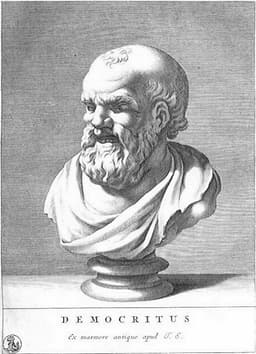
Democritus
Atoms and void. The universe is particles in motion, and cheerfulness is the goal.
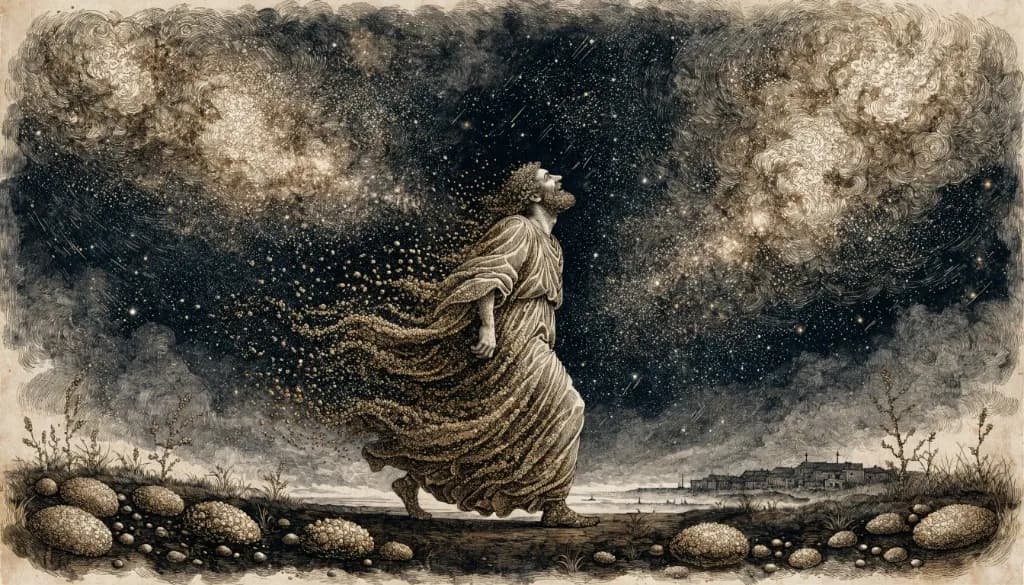
Democritus imagined the world as atoms: indivisible particles moving through empty space, combining and separating to form everything we see. No gods required. He traveled widely, wrote on everything from ethics to embryology, and was said to laugh at human folly. His cheerful materialism anticipated modern science by two thousand years, though most of his writings are lost.

What survives
His book is lost. 5 lines survive, each because a later writer quoted it.
Places
Ideas
Words
“Nothing exists except atoms and empty space; everything else is opinion.”
“Happiness resides not in possessions, and not in gold. Happiness dwells in the soul.”
“By convention sweet, by convention bitter, by convention hot, by convention cold, by convention color; but in reality, atoms and void.”
“The soul is the same as the body's fire: it is made of small, smooth, round atoms like those of fire.”
“Cheerfulness is the best thing for a person, and its absence makes life not worth living.”
Works
On Mind
fragmentaryOne sentence is all that survives in Leucippus' own words, and it states the principle atomism was built on: that nothing is arbitrary. His larger book, The Great World-System, is lost, and ancient readers already disagreed over whether it was his or his student's.
Fragments on Atoms and the Void
fragmentaryDemocritus wrote prolifically (over 70 works by some accounts) but only fragments survive. They reveal a thinker concerned equally with physics and ethics, atoms and cheerfulness.
Ethical Fragments
fragmentaryDemocritus was as much a moralist as a physicist. His ethical fragments praise cheerfulness, moderation, and the inner life of the soul over wealth and reputation.
Life & Moments
Born in Abdera
Born in Abdera on the Thracian coast, a town already associated with bold and unconventional thinkers.
Born in Abdera
Democritus is born around 460 BCE in Abdera, a Thracian city that other Greeks found easy to mock. He grows up in a prosperous household, his father leaves him enough money to travel half the known world. He spends it all on that.
Years of Travel
Tradition says Democritus wandered widely, from Egypt and Persia to Greece, gathering observations on nature, culture, and custom.
Travels East, Spends Inheritance
Democritus uses his inheritance to travel for years: Egypt, Persia, possibly India, possibly Ethiopia. He studies with priests, astronomers, and mathematicians wherever he goes. He returns to Abdera with nothing but notes. He will later say he has traveled more widely and inquired into more things than any other person of his time, and he probably means it.
Develops Atomic Theory
Working with his teacher Leucippus, Democritus proposes that everything is made of atoms, uncuttable pieces of matter moving through empty space. The atoms have shape and size but no color, taste, or smell; those qualities exist only in perception. By combining and separating, atoms produce every object and event in the world. No divine will is required. The theory sits unused for two thousand years before physics catches up.
Atoms and Void
Democritus argued that reality consists of atoms moving through empty space, combining and separating without purpose or design.
Writes Across Many Subjects
Democritus writes more than seventy works: on physics, mathematics, music, medicine, ethics, agriculture, painting. Thrasyllus catalogued them in groups of four, like Plato's dialogues. Almost none survive. What remains are short fragments on ethics, mostly about cheerfulness: the goal of life is a quiet mind, not pleasure. He is said to have laughed often at human foolishness, which earned him the name the laughing philosopher.
In Athens, Unnoticed
Democritus visited Athens, but Socrates, it is said, never noticed him. The anecdote may sting, yet his influence outlasted many more famous contemporaries.
Death in Abdera
Democritus died in old age, reportedly blind but still cheerful, having written on nearly every subject known to his age.
Dies in Abdera
Democritus dies around 370 BCE in Abdera, reportedly at an advanced age, some sources say over a hundred. The stories say he was still laughing near the end. He outlived Socrates, Parmenides, and nearly everyone who had shaped his world. What he built in words is mostly gone, but the shape of his idea (matter, void, and no gods needed) returns in Epicurus, in Lucretius, and eventually in atomic physics.
Influence
Influenced by
- Leucippus
Leucippus proposed atoms and the void; Democritus worked the idea into a system so thoroughly that ancient writers already struggled to say which parts belonged to which man.
Influenced
- Epicurus
Epicurus built his physics on Democritus’ atomism, adding the famous ‘swerve’ to allow for free will. He admired Democritus more than any other predecessor.
- Protagoras
Ancient tradition links the two men as citizens of Abdera and sometimes as teacher and student, though the chronology is uncertain and they drew opposite conclusions from a shared interest in how things appear.


