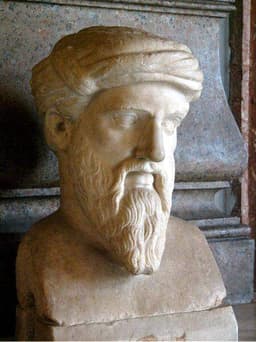
Pythagoras
Number is the language of the cosmos. He built a life around that belief.
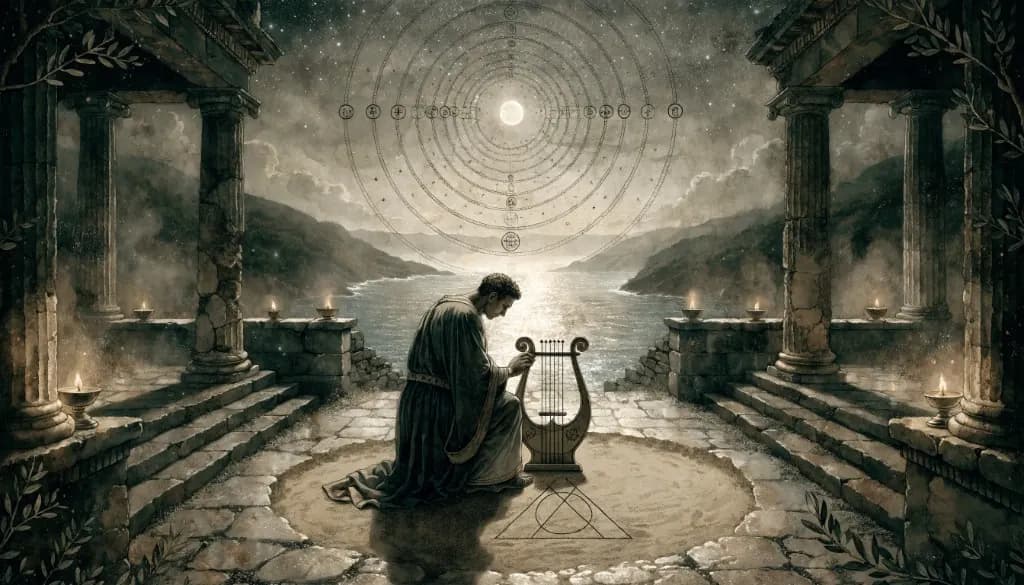
Pythagoras saw mathematics not as a tool but as truth itself. The harmony of a lyre string, the orbit of the stars, the structure of the soul; all governed by number. He left Samos for Croton, where he founded a community that was part school, part religion, part political movement. His legacy is split between the theorem that bears his name and the mystical idea that understanding the world means hearing its music.

Read in the Library
Places
Ideas
Words
“Number is the ruler of forms and ideas, and the cause of gods and daemons.”
“There is geometry in the humming of the strings. There is music in the spacing of the spheres.”
“Above all things, reverence yourself.”
Works
The Life & Doctrines
attributedPythagoras founded a religious community as much as a school. Later sources (Iamblichus, Porphyry, Diogenes Laertius) preserved his teachings on number, music, the transmigration of souls, and the rules of the Pythagorean way of life.
The Golden Verses
attributedA collection of moral precepts attributed to Pythagoras, though likely composed by later followers. The verses outline a daily practice of self-examination, moderation, and reverence for the cosmic order.
Life & Moments
Born on Samos
Born on the island of Samos, a wealthy trading center known for its engineering achievements. Tradition says he traveled to Egypt and Babylon before returning to begin his philosophical career.
Born in Samos
Pythagoras is born on the island of Samos, a prosperous Aegean city with strong ties to Egypt and the East. The island produces sailors, merchants, and engineers. He grows up watching ships come and go, carrying goods and knowledge across the sea.
Travels to Egypt and Babylon
The accounts say Pythagoras spent years in Egypt studying with priests, then in Babylon where Chaldean astronomers kept careful records of the stars. He returned carrying the mathematics of both civilizations. Whether the journeys happened as described, his number theory and astronomy show marks of both traditions: the Egyptian feel for geometry, the Babylonian feel for patterns in the sky.
Leaving Samos
Tradition says Pythagoras left Samos to escape the tyranny of Polycrates, carrying his search for cosmic order beyond his native island.
Community at Croton
Pythagoras established a community in Croton that combined philosophical inquiry with religious practice. Members followed strict rules: shared property, vegetarianism, and silence for the first years of study.
Founds Community in Croton
Around 530 BCE Pythagoras settles in Croton, a Greek colony in southern Italy, and builds something unusual: a community of men and women who live together under shared rules, study mathematics, and practice ritual silence. They believe that numbers are the deep structure of reality: that harmony in music, the planets, and the soul all run on the same ratios.
Number as Cosmos
The Pythagoreans taught that number is the hidden structure of reality, from musical harmony to the motion of the heavens.
The Croton Crisis
The Pythagorean community eventually faced violent opposition. Pythagoras reportedly fled and died in Metapontum, but the brotherhood's ideas outlived its politics.
Expelled from Croton
Political violence ends the community at Croton. A rival faction burns the meeting houses and drives the Pythagoreans out. Pythagoras flees to Metapontum, another Italian Greek city, and dies there not long after. The community he built scatters but does not vanish: Pythagorean ideas about number, soul, and transmigration keep circulating for centuries.
Influence
Influenced by
- Thales
Thales may have encouraged the young Pythagoras to travel to Egypt. The Milesian tradition of natural inquiry set the stage for Pythagoras’ mathematical cosmology.
Influenced
- Empedocles
Empedocles' claim to have been a boy, a girl, a bush, a bird and a fish belongs to the Pythagorean doctrine of the soul's transmigration, which had spread through the Greek cities of Sicily and southern Italy.

