Fragments
What survives of Anaximander
Nothing Anaximander wrote survives complete. One line reached us, copied into a later writer's own work while he was arguing about something else.
The Fragility of Ancient Papyrus
None of the early Greek philosophers left manuscripts that survived antiquity. Their prose books and philosophical poems disappeared into the dust of Mediterranean library fires, political upheavals, and decay. The few sentences we possess today survived solely because later commentators—from Aristotle and Simplicius to Diogenes Laërtius and Sextus Empiricus—quoted them while writing treatises of their own centuries later.
DK 12 B1, Wording disputed
Simplicius, Commentary on Aristotle's Physics 24.13 (c. 540 CE)
A commentator setting out what the earliest thinkers had said about the origin of things. He was reading Theophrastus, Aristotle's pupil, who had summarised Anaximander eight centuries before him — so the line reaches us at two removes and through a summary.
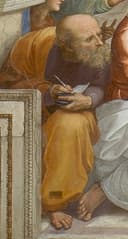
Anaximander
(c. 610 BCE – c. 546 BCE)A younger associate of Thales, Anaximander refused to ground the world in any single element. Water, air, fire are all limited, and what limits cannot be the source of everything. So he proposed the apeiron, the boundless, an indefinite stuff from which all opposites separate out and into which they return. He drew the first map of the known world, built a sundial, and argued that the earth floats unsupported at the center of things, held by nothing because it has no reason to fall one way rather than another. He even guessed that humans must have descended from other animals, since a human infant could never have survived alone.
Quotes & Sayings by Anaximander
“From what things existing things come to be, into these they pass away according to necessity; for they pay the penalty to one another for their injustice according to the ordering of time.”
“The earth hangs free, held up by nothing, remaining in place because it is equally distant from all things.”