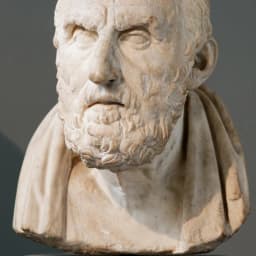
Chrysippus
An ancient saying held that if it were not for Chrysippus, there would be no Stoa, he took a promising school of thought and turned it into an unbreakable logical system.
Chrysippus arrived in Athens from Cilicia to study under Cleanthes, the plodding second head of the Stoic school, and by most ancient accounts quickly outgrew him. Where Zeno had founded Stoicism and Cleanthes had preserved it, Chrysippus systematized it, and the systematizing was so thorough that later writers credited him with saving the school from irrelevance. He built Stoic logic into a rigorous propositional system, developing forms of argument that anticipated formal logic by two thousand years, and reportedly used a story about a dog to illustrate a point about inference: tracking a scent to a fork in the road, the dog sniffs two paths, finds nothing, and bolts down the third without even checking it, having in effect performed a disjunctive syllogism. He wrote with a compulsive, almost defensive thoroughness, producing some seven hundred works meant to anticipate and demolish every objection an opponent could raise, particularly against the rival Academy's skeptics. Almost none of it survived intact; what remains is fragments, summaries, and hostile paraphrases in later writers like Plutarch and Cicero, along with a handful of scorched papyrus scraps recovered from a villa buried at Herculaneum. He also wrestled honestly with the hardest problem Stoic determinism creates: if everything unfolds by fate, how can anyone be praised or blamed for anything, and his attempt to preserve human responsibility within a fully deterministic universe still gets cited in debates about free will today. He is said to have died laughing at his own joke after watching a donkey eat figs and drink wine, a very undignified end for the man who had made Stoicism dignified enough to survive.

Places
Ideas
Words
“If it were not for Chrysippus, there would be no Stoa.”
“Fate is a sempiternal cause of things, why past things happened, present things now happen, and future things will happen.”
Works
Life & Moments
Illustrates disjunctive syllogism with a dog
Chrysippus used the image of a hunting dog that tracks a scent to a fork in the road, checks two paths, finds nothing, and bolts down the third without even sniffing it, to illustrate a rigorous form of logical inference, a fragment preserved by later skeptical writers mocking the comparison.
Becomes third head of the Stoa
Chrysippus succeeded Cleanthes as head of the Stoic school in Athens and set about systematizing its logic and physics so thoroughly that later writers credited him with saving Stoicism from irrelevance.
Influence
Influenced by
- Zeno of Citium
Chrysippus inherited the Stoic school Zeno of Citium had founded and rebuilt its logic and physics into a rigorous system so thorough that ancient writers credited him, not Zeno, with saving Stoicism from irrelevance.
Influenced
- Epictetus
The technical Stoic system Chrysippus built centuries earlier in Athens supplied the logical scaffolding beneath Epictetus's more practical, ethically focused teaching in Rome, Epictetus quoted and argued with Chrysippus's texts directly.
- Seneca
Seneca worked from the systematic Stoicism Chrysippus had built, though he wrote letters and essays rather than treatises and cared more about how a person gets through the day than about the logic underneath.
Engage with Chrysippus
Explore structured paths, classic debates, and thought experiments featuring this thinker.
Introduction to Stoicism: Inner Fortitude
Discover how an ancient philosophy born in the painted colonnades of Athens became the world's most resilient operating system for stress, adversity, and mental freedom.


