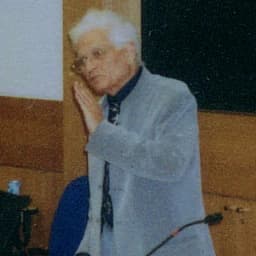
Jacques Derrida
He read every text to find what it was trying to suppress, and found that every text was trying to suppress something.
Derrida grew up in Algeria as a Sephardic Jewish outsider to French culture, and spent his career reading the texts that formed the background of Western philosophy. Deconstruction is not destruction but a practice of close reading that attends to the tensions within a text that the text itself cannot resolve. Every philosophical text establishes a hierarchy of terms (speech over writing, presence over absence, nature over culture) and deconstruction shows how the supposedly subordinate term is necessary for the dominant one. He applied this to Plato, Rousseau, Hegel, Husserl, Heidegger, Freud, and Austin. The result was not nihilism but a permanent alertness to what any account of things has had to exclude. He wrote with deliberate difficulty because he did not trust the clarity that smoothed over these exclusions, and because he believed the form of a philosophical text was never innocent of its content.


Places
Ideas
Words
“There is nothing outside the text.”
“Deconstruction never proceeds without love.”
Works
Life & Moments
Three founding texts published in one year
In 1967, Derrida published three books simultaneously: Of Grammatology, Writing and Difference, and Speech and Phenomena. The explosion created deconstruction as a program. The conceptual vocabulary (différance, trace, supplement, iterability) was established all at once, and philosophy has been arguing over it since.
Honorary degree controversy at Cambridge
When Cambridge proposed an honorary doctorate for Derrida in 1992, nineteen philosophers from around the world signed a letter of protest, arguing that his work was not serious philosophy. Cambridge voted to proceed. The episode crystallized the divide between analytic and Continental philosophy.
Influence
Influenced by
- Martin Heidegger
Heidegger's method of dismantling the tradition's hidden assumptions to uncover buried questions became Derrida's deconstruction: applied not only to metaphysics but to all texts, all hierarchies, all presumptions of presence.
- Edmund Husserl
Derrida's first published work was an introduction to Husserl's Origin of Geometry, and the deconstructive method grew out of noticing where Husserl's own text could not maintain the distinctions it needed.
- Friedrich Nietzsche
Derrida takes from Nietzsche the suspicion that philosophical concepts are worn metaphors whose figurative origin has been forgotten, and the willingness to treat style as part of the argument.
Influenced
- Richard Rorty
Rorty admired Derrida while refusing the apparatus, reading him as a private ironist rather than a theorist of language, a domestication Derrida's followers resented and Rorty defended.
- Judith Butler
Performativity depends on the thought that an act gets its force from being a repetition of prior acts, none of which is the original, which is the structure Derrida called iterability.


