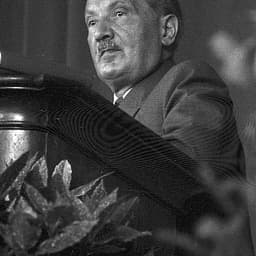
Martin Heidegger
He asked the question everyone else had forgotten: what does it mean to be? And then joined the Nazi Party. The two facts cannot be separated.
Heidegger asked the question he thought everyone else had forgotten: what does it mean to be? Not to be a thing, or a mind, or a social role, but to exist at all: to be thrown into a world not of your choosing, understanding yourself only partially, moving toward a death that cannot be shared or deferred. Being and Time, published in 1927, analyzes the structure of human existence through anxiety, care, temporality, and authenticity: the possibility of owning one's life rather than letting it be lived by convention and distraction. It changed phenomenology, existentialism, hermeneutics, and philosophy of language. In 1933 he joined the Nazi Party and became Rector of Freiburg University. He never adequately explained this. His later work, on technology, language, and the withdrawal of Being, is read and argued over. The question of how the most important ontologist of the century could have done what he did has no satisfying answer.


Places
Ideas
Words
“Why is there something rather than nothing?”
“We are ourselves the entities to be analyzed.”
Works
Life & Moments
Being and Time published
Being and Time appeared in 1927, when Heidegger was thirty-seven and teaching at Marburg. Written under pressure to produce publications, it transformed twentieth-century philosophy. Its central question, the meaning of Being, had not been seriously asked since the Greeks, Heidegger argued, and answering it required taking apart the tradition that had forgotten it.
Nazi rector of Freiburg University
In 1933, Heidegger joined the Nazi Party and accepted the rectorship of Freiburg University. His inaugural address interpreted National Socialism through the lens of his own philosophy. He resigned the rectorship in 1934, but did not publicly recant his support. After the war he was stripped of his teaching rights until 1951. The question of how his philosophy relates to his politics remains open.
Influence
Influenced by
- Edmund Husserl
Heidegger was Husserl's assistant at Freiburg and his designated successor. He dedicated Being and Time to Husserl, then rerouted phenomenology away from consciousness toward Being, a move Husserl never accepted.
- Friedrich Nietzsche
Heidegger devoted years to interpreting Nietzsche, seeing him as the culmination of Western metaphysics rather than its escape. The death of God was the revelation of nihilism, and overcoming it required rethinking Being from the ground up.
- Søren Kierkegaard
Heidegger's analysis of anxiety as the mood in which one's own existence becomes a question is worked out on ground Kierkegaard cleared, a debt the footnotes acknowledge more readily than the text.
Influenced
- Jean-Paul Sartre
Being and Time gave Sartre the vocabulary for Being and Nothingness: facticity and transcendence, authenticity and bad faith. Heidegger later complained that Sartre had humanized, and missed, what Being and Time was about.
- Hannah Arendt
Arendt studied with Heidegger in Marburg in 1924-25. Their relationship was personal and intellectual. She took his analysis of publicness and authenticity and turned it toward politics and plural human action, where he had left a gap.
- Jacques Derrida
Heidegger's method of dismantling the tradition's hidden assumptions to uncover buried questions became Derrida's deconstruction: applied not only to metaphysics but to all texts, all hierarchies, all presumptions of presence.
- Richard Rorty
Rorty drew on Heidegger's diagnosis that Western philosophy's fixation on stable presence and foundations was a historically contingent choice rather than a discovery about the nature of thought, feeding directly into his own attack on philosophy-as-mirror.
- Paul Ricoeur
Ricoeur accepted the hermeneutic turn Heidegger gave phenomenology, that understanding is not a method applied from outside but the way a being like us already exists, and then insisted on the long detour through texts that Heidegger skipped.
Engage with Martin Heidegger
Explore structured paths, classic debates, and thought experiments featuring this thinker.
Existentialism: Freedom, Anxiety & Meaning
When pre-packaged meaning collapses, freedom becomes terrifying. Learn how existentialist thinkers turned dread into authentic responsibility.


