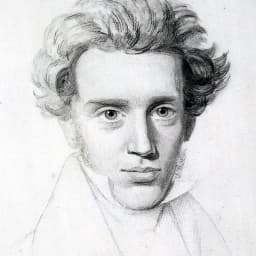
Søren Kierkegaard
He fought his whole life against comfortable Christianity, and argued that the truth of existence cannot be captured in any system.
Kierkegaard spent his life in Copenhagen and fought his whole life against one thing: the comfortable Christianity of his day, which had smoothed the leap of faith into a Sunday habit. He wrote pseudonymously, from multiple perspectives (the aesthete, the ethicist, the knight of faith), arguing that the truth of existence cannot be captured in a system. The three stages of existence (aesthetic, ethical, religious) are not a ladder but a series of leaps, each requiring the abandonment of what came before. The leap to the religious is the most radical: Abraham raising the knife over Isaac, suspended between the universal moral law and the singular demand of God. Kierkegaard called this the teleological suspension of the ethical. He called the state before the leap anxiety, the dizziness of freedom. He died at forty-two, still fighting the bishop.

Places
Ideas
Words
“Life can only be understood backwards; but it must be lived forwards.”
“The most common form of despair is not being who you are.”
Works
Life & Moments
Breaks off engagement to Regine Olsen
In 1841, Kierkegaard broke off his engagement to Regine Olsen, a decision that haunted him for the rest of his life. He never explained it fully. He continued to write about her, thinly disguised, for years afterward. The act, and the anguish around it, animated his sustained thinking about choice, guilt, and repetition.
Either/Or published under a pseudonym
In 1843, Kierkegaard published Either/Or under the name 'Victor Eremita.' Within weeks, Copenhagen knew it was his. The book staged two modes of existence in ironic juxtaposition, and it made him famous in Denmark: a fame he found troubling, because he had hoped to be misunderstood.
Attack on the established Church
In the last year of his life, 1854-55, Kierkegaard launched a campaign against the Danish State Church, publishing a series of pamphlets called The Moment. He argued that the official church had made Christianity comfortable and therefore ceased to be Christianity. He collapsed in the street in October 1855 and died weeks later.
Influence
Influenced by
- G.W.F. Hegel
Kierkegaard's entire philosophy is a rebellion against Hegel: against the System that swallowed the individual, against the objective that forgot the subjective, against a reason that had no room for the leap of faith.
- Pascal
Kierkegaard's insistence that faith is a decision made without sufficient reason, and that this is its nature rather than its defect, continues a line of thought Pascal had opened two centuries earlier.
- Socrates
Kierkegaard's dissertation was on Socratic irony, and the pseudonyms, the indirect communication and the refusal to hand the reader a doctrine are all attempts to do in Copenhagen what Socrates did in Athens.
Influenced
- Martin Heidegger
Heidegger's analysis of anxiety as the mood in which one's own existence becomes a question is worked out on ground Kierkegaard cleared, a debt the footnotes acknowledge more readily than the text.
- Jean-Paul Sartre
Sartre inherited from Kierkegaard the conviction that a human being is not a kind of thing with a nature to fulfil but a freedom that has to choose itself, and stripped it of the faith Kierkegaard thought the point.
Engage with Søren Kierkegaard
Explore structured paths, classic debates, and thought experiments featuring this thinker.
Existentialism: Freedom, Anxiety & Meaning
When pre-packaged meaning collapses, freedom becomes terrifying. Learn how existentialist thinkers turned dread into authentic responsibility.
Kierkegaard vs. Nietzsche
The Knight of Faith vs. The Antichrist: Should we leap into the divine or overcome God?