Journey/

Søren Kierkegaard

Existentialist
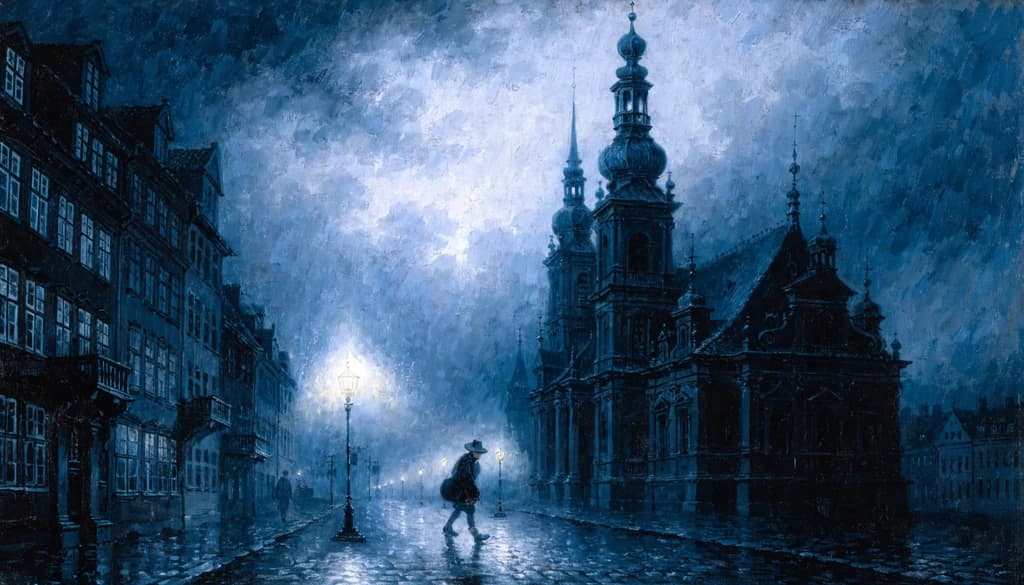
Rain-slicked Copenhagen cobblestones at midnight, gaslit reflections, a lone figure crossing toward a baroque church whose spires dissolve in winter fog.
Subjectivity is truth.
1/3

Kierkegaard spent his life in Copenhagen and fought his whole life against one thing: the comfortable Christianity of his day, which had smoothed the leap of faith into a Sunday habit. He wrote pseudonymously, from multiple perspectives (the aesthete, the ethicist, the knight of faith), arguing that the truth of existence cannot be captured in a system. The three stages of existence (aesthetic, ethical, religious) are not a ladder but a series of leaps, each requiring the abandonment of what came before. The leap to the religious is the most radical: Abraham raising the knife over Isaac, suspended between the universal moral law and the singular demand of God. Kierkegaard called this the teleological suspension of the ethical. He called the state before the leap anxiety, the dizziness of freedom. He died at forty-two, still fighting the bishop.

Moment

Breaks off engagement to Regine Olsen

In 1841, Kierkegaard broke off his engagement to Regine Olsen, a decision that haunted him for the rest of his life. He never explained it fully. He continued to write about her, thinly disguised, for years afterward. The act, and the anguish around it, animated his sustained thinking about choice, guilt, and repetition.

Words

“Life can only be understood backwards; but it must be lived forwards.”