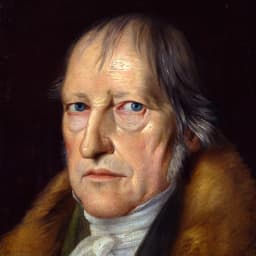
G.W.F. Hegel
He tried to say everything at once (that history is reason unfolding, that mind and world are one) and nearly managed it.
Hegel is the thinker you must pass through to get to almost everything that follows him. His Phenomenology of Spirit describes consciousness's long journey toward knowing itself (through self-certainty, through other people, through history) until it reaches the knowledge that mind and world are one. His Logic is stranger: an attempt to show that pure thought, followed to its own end, generates all the categories of reality. His Philosophy of Right gives us the modern theory of the state, civil society, and the institutions that connect individual freedom to collective life. He is difficult, partly by nature and partly by design. Kierkegaard attacked him for making individual existence abstract. Marx turned him upside down. Nietzsche dismissed him. All three needed him to do it. He remains the pivot of modern thought: the thinker who tried to say everything at once, and nearly managed it.

Places
Ideas
Words
“The owl of Minerva spreads its wings only with the falling of the dusk.”
“What experience and history teach is this — that peoples and governments have never learned anything from history, nor acted on lessons they might have drawn from it.”
Works
Phenomenology of Spirit
Hegel's first masterwork, written at speed while Napoleon's cannons sounded outside Jena. It follows consciousness on a journey through its own shapes (from simple sense-certainty through self-consciousness, culture, morality, and religion) until mind recognizes itself in all it encounters. No book in Western philosophy is more demanding or more consequential.
Philosophy of Right
Hegel's political philosophy, tracing freedom through the three spheres of abstract right, morality, and ethical life (family, civil society, the state). Its preface contains the famous remark about the owl of Minerva: reason grasps an age only when it is already passing away.
Life & Moments
Phenomenology finished as Napoleon enters Jena
Hegel completed the Phenomenology of Spirit on the eve of the Battle of Jena in 1806, reportedly writing the final pages while cannon fire sounded outside his window. He glimpsed Napoleon crossing the city the next morning and wrote to a friend that he had seen the World-Soul on horseback.
Professor and rector in Berlin
Appointed to the chair of philosophy at the University of Berlin in 1818, Hegel became the dominant intellectual figure of Germany. Students filled his lectures; his system became the official philosophy of the Prussian state. His lectures on history, art, religion, and philosophy drew hearers from across Europe.
Death by cholera
Hegel died in Berlin in November 1831, within a year of a cholera epidemic that swept through Europe. He had barely published a single new book in more than a decade, lecturing instead. His students compiled his lectures from notes and published them posthumously, the bulk of what we read as Hegel today.
Influence
Influenced by
- Immanuel Kant
Hegel took the Kantian system as his starting point and tried to complete what Kant left unfinished: showing that thought and being are not separate sides to be bridged, but already one.
Influenced
- Karl Marx
Marx stood Hegel on his head: the Hegelian dialectic of ideas became the materialist dialectic of economic forces. He kept the logic of contradiction and development while replacing Spirit with the labor of actual human beings.
- Søren Kierkegaard
Kierkegaard's entire philosophy is a rebellion against Hegel: against the System that swallowed the individual, against the objective that forgot the subjective, against a reason that had no room for the leap of faith.
- John Dewey
Dewey began his philosophical career as a fairly orthodox Hegelian, drawn to systems that reconciled apparent conflicts into higher unities, before pragmatism pulled him toward a more experimental, provisional cast of mind.
- Ludwig Feuerbach
Feuerbach trained as a devoted Hegelian in Berlin before concluding that Hegel's Absolute Spirit was itself a kind of theological projection, inverting his teacher's idealism into a humanist materialism.
- Friedrich Engels
Engels, like Marx, absorbed Hegel's dialectical method of understanding history as a process of conflict and resolution, then inverted its idealist premise to argue that material and economic conditions, not the unfolding of Spirit, drive historical change.
- Judith Butler
Butler's first book was on the reception of Hegel's account of desire in twentieth-century France, and the idea that a subject comes into being through recognition by another runs through everything after it.