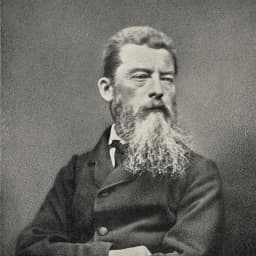
Ludwig Feuerbach
He argued that God is nothing but humanity's own best qualities, projected outward and mistaken for someone else, and handed the young Karl Marx a method he would turn on economics itself.
Feuerbach began as a theology student and then a devoted Hegelian, sitting in Berlin lecture halls absorbing Hegel's vision of history as the unfolding self-realization of Absolute Spirit, before deciding the whole architecture had the relationship between humanity and divinity backwards. The Essence of Christianity, his defining book, argued that theology is really anthropology that has forgotten itself: when people describe God as all-loving, all-wise, and all-powerful, they are not describing some being external to humanity but projecting their own best and most idealized qualities outward, then bowing down to worship the projection as though it had an independent existence. Religion, on this account, is not simply false but revealing: a kind of dream-language in which humanity confesses, without realizing it, what it actually values and secretly believes itself capable of. The book scandalized German academic life and cost him any real chance at a university post, forcing him into decades of relatively isolated writing at his wife's family estate before eventually declining into poverty. Its real historical afterlife, though, ran through a young philosophy student named Karl Marx, who initially found the argument to be liberating, only to write his brief, blistering Theses on Feuerbach a few years later: arguing that Feuerbach had correctly unmasked religion as a human projection but had never asked what social and economic conditions made humans need such projections in the first place, and that criticizing heaven was useless unless you also went on to criticize earth.

Places
Ideas
Words
“Man made God in his own image.”
“The turning point of history will be the moment man becomes aware that the only God of man is man himself.”
Works
Life & Moments
Publishes The Essence of Christianity
Feuerbach's argument that theology is anthropology in disguise scandalized German academic life, cost him any real chance at a university post, and profoundly shaped the young Karl Marx.
Withdraws to rural isolation
Unable to secure a university position after the controversy over his work, Feuerbach withdrew to his wife's family estate for decades of relatively isolated writing before declining into poverty.
Influence
Influenced by
- G.W.F. Hegel
Feuerbach trained as a devoted Hegelian in Berlin before concluding that Hegel's Absolute Spirit was itself a kind of theological projection, inverting his teacher's idealism into a humanist materialism.
- Baron d'Holbach
Holbach's account of religion as a product of fear and ignorance prepares the ground for Feuerbach's more careful argument that God is human nature projected outward.
Influenced
- Karl Marx
Marx found Feuerbach's unmasking of religion as human projection liberating before writing his brief, blistering Theses on Feuerbach, arguing that Feuerbach never asked what economic conditions made humans need such projections in the first place.


