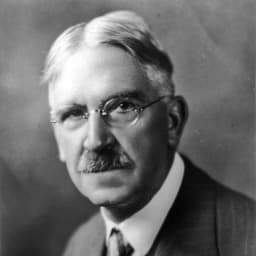
John Dewey
He argued that ideas are tools for solving real problems rather than mirrors of eternal truth, and spent a long public career trying to rebuild education and democracy on that basis.
Dewey began his philosophical life as a fairly orthodox Hegelian, drawn to grand systems that reconciled all apparent conflicts into a higher unity, before the pragmatism of Peirce and James pulled him toward a far more experimental, provisional cast of mind. His instrumentalism held that ideas, theories, and even truth itself are best understood as tools: instruments developed to solve specific problems that arise within lived experience, to be judged by whether they work rather than by how well they mirror some fixed, prior reality. He applied this conviction most influentially to education. Democracy and Education argued that children do not learn by having facts poured into passive minds, but by encountering real problems, testing ideas against consequences, and gradually building the habits of inquiry and cooperation that a functioning democracy actually requires: schools, in his view, should be miniature democratic communities, not factories for obedience. He spent decades at the University of Chicago and then Columbia, but never confined himself to the university: he wrote constantly for a general public on politics, art, religion, and psychology, co-founded the American Civil Liberties Union, chaired an international commission that traveled to Mexico to hear Leon Trotsky's defense against Stalin's charges against him, and remained a visible public intellectual into his nineties. He insisted throughout that philosophy divorced from the actual problems of an actual society was a kind of failure of nerve, that the whole point of thinking hard was to make some concrete difference in how people actually lived together.

Places
Ideas
Words
“Education is not preparation for life; education is life itself.”
“We do not learn from experience... we learn from reflecting on experience.”
Works
Life & Moments
Publishes Democracy and Education
Dewey argued that schools should function as miniature democratic communities where children learn through encountering real problems, a book that reshaped progressive education across the twentieth century.
Chairs the Dewey Commission
In his late seventies, Dewey chaired an international commission that traveled to Mexico to hear Leon Trotsky's defense against Stalin's charges, concluding that the Moscow trials had been fraudulent.
Influence
Influenced by
- C.S. Peirce
Dewey built his instrumentalism on the pragmatist foundation Peirce had laid down technically and James had popularized, treating ideas as tools tested by their consequences rather than mirrors of fixed truth.
- G.W.F. Hegel
Dewey began his philosophical career as a fairly orthodox Hegelian, drawn to systems that reconciled apparent conflicts into higher unities, before pragmatism pulled him toward a more experimental, provisional cast of mind.
Influenced
- Cornel West
West's The American Evasion of Philosophy treats Dewey, alongside Emerson and James, as an unfinished pragmatist resource for thinking about democracy, a debt already named in West's own writing before Dewey had an entry of his own here.
- Richard Rorty
Rorty explicitly named Dewey, alongside Wittgenstein and Heidegger, as one of the three philosophers whose work pointed beyond the search for secure epistemological foundations toward treating inquiry as an ongoing, self-correcting social practice.
- Kwasi Wiredu
Wiredu drew on pragmatism's suspicion of questions that make no practical difference, using it to argue that African philosophy should neither imitate Europe nor simply catalogue tradition.


