Atlas of Thinkers
ThinkersAtlasTimelineWorksBlog

Atlas of Thinkers

A story-first philosophy atlas. Explore history's greatest thinkers through place, time, movement, and ideas.

Explore

  • Thinkers
  • Atlas
  • Works

Browse

  • Concepts
  • Volumes

About

  • About the Atlas
  • Image Credits

Volume I · Ancient Greece · 624-262 BCE

Atlas of Thinkers
ThinkersAtlasTimelineWorksBlog
  1. Home
  2. /Thinkers
  3. /Leibniz
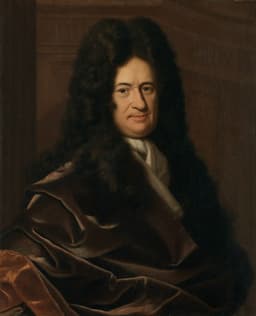
Portrait of Leibniz

Leibniz

Early ModernRationalist

Born 1646 CE

Died 1716 CE

This is the best of all possible worlds. He invented calculus, dreamed of a universal language, and believed God chose this universe from an infinite menu.

Leibniz was a polymath who worked as a diplomat, librarian, and courtier in Hanover. He invented calculus independently of Newton (sparking the most bitter priority dispute in the history of science), designed a mechanical calculator, and dreamed of a universal logical language that would settle all disputes by computation. His Monadology proposes that reality consists of simple, mind-like substances called monads, each reflecting the entire universe from its own perspective. God, the supreme monad, chose to create this world because it is the best of all possible worlds. Voltaire mocked this idea. Leibniz died in 1716, largely forgotten.

Leibniz at Hanover court with monad diagrams and calculus notation, best of all possible worlds unfolding.
This is the best world.

Places

Ideas

ReasonBeing

Words

“This is the best of all possible worlds.”

— Leibniz

Works

Monadology

·French

Ninety short paragraphs describing reality as composed of simple, mind-like substances called monads, each reflecting the entire universe from its own perspective.

Life & Moments

1646 CE

Born in Leipzig

Born to a professor of moral philosophy at the University of Leipzig. His father died when he was six, leaving behind a large library. The boy taught himself Latin by age twelve, working through the books on his own.

c. 1675 CE

Develops the Calculus

While living in Paris, Leibniz independently developed the infinitesimal calculus, inventing the notation still used today. Newton had arrived at similar results earlier but published later. The priority dispute between them became one of the ugliest in the history of science.

1714 CE

Writes the Monadology

Wrote the Monadology, a short work laying out his mature metaphysics. Reality, he argued, is composed of simple, indivisible substances called monads, each reflecting the entire universe from its own perspective. It was ninety paragraphs long and contained an entire philosophy.

1716 CE

Death in Hanover

Died in Hanover largely forgotten, his funeral unattended by court or academy. Voltaire would later mock his best of all possible worlds, but the calculus and the monads endured.

Influence

Influenced by

  • ←
    Descartesrival and successor

    Leibniz developed his monadology partly in response to problems in Cartesian physics and metaphysics.

  • ←
    Anne Conwayinfluence

    Leibniz read Conway's treatise and borrowed her term, the monad, for the living units at the base of his system.

Influenced

  • →
    Voltairesatirical target

    Leibniz's claim that this is the best of all possible worlds is the direct target of Candide. Pangloss is a caricature of Leibnizian optimism.

Related Thinkers

Portrait of Voltaire

Voltaire

1694 CE – 1778 CE

Portrait of Descartes

Descartes

1596 CE – 1650 CE

Portrait of Anne Conway

Anne Conway

1631 CE – 1679 CE

Read the Journey →Compare with Voltaire

Atlas of Thinkers

A story-first philosophy atlas. Explore history's greatest thinkers through place, time, movement, and ideas.

Explore

  • Thinkers
  • Atlas
  • Works

Browse

  • Concepts
  • Volumes

About

  • About the Atlas
  • Image Credits

Volume I · Ancient Greece · 624-262 BCE