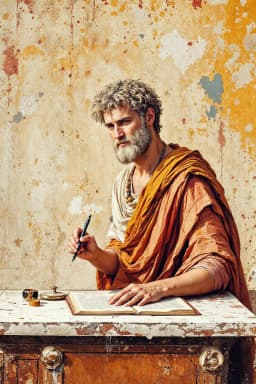
Lucretius
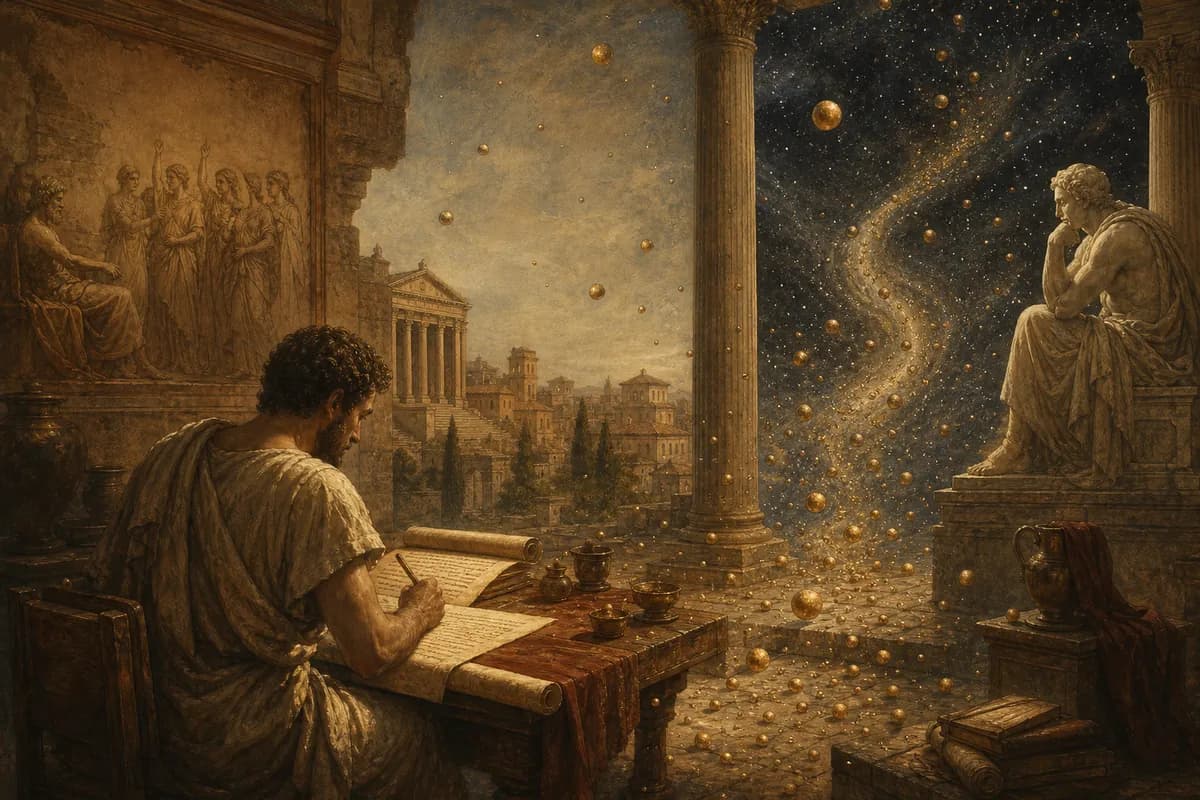
He wrote the universe in verse. Atoms falling through the void, swerving into freedom. Epicurus made poetry.
Almost nothing is known about Lucretius the man. What survives is a single long poem, De Rerum Natura, which sets out the entire Epicurean physics in Latin hexameters. It argues that the world is made of atoms moving through void, that the soul is mortal, that the gods do not intervene in human affairs, and that fear (of death, of the gods, of the unknown) is the root of all human misery. The poem was lost for a thousand years, rediscovered in a German monastery in 1417, and helped spark the Renaissance.

Read in the Library
Places
Ideas
Words
“Nothing is ever created by divine power out of nothing.”
“The drops of rain make a hole in the stone not by violence but by oft falling.”
Works
Life & Moments
Born
Almost nothing is known about his life. No letters, no anecdotes, no reliable biography. He exists for us entirely through his poem.
De Rerum Natura
Lucretius composed a six-book poem explaining Epicurean physics: atoms, void, mortality, the swerve. It was meant to free the reader from fear of the gods and death. Cicero read it and admired its artistry. It survived by a thread, rediscovered in a German monastery in 1417.
The Atomic Swerve
In Book Two, Lucretius introduces the clinamen: atoms swerve slightly, breaking the chain of necessity and making room for freedom.
Freeing the Reader from Fear
The poem's deepest aim is therapeutic: to cure the fear of death and divine punishment by showing that souls dissolve and gods do not meddle.
Death
Died around the same time his poem was published. Later sources claimed he was driven mad by a love potion and killed himself, but this is almost certainly slander by Christian writers hostile to his materialism.
Influence
Influenced by
- Epicurus
Lucretius regarded Epicurus as a liberator of humanity. De Rerum Natura is a poetic monument to Epicurean physics.
- Empedocles
Lucretius singles Empedocles out for praise in On the Nature of Things, admiring both his decision to write philosophy as poetry and his account of a world built from elements, even while replacing his four roots with atoms.
Influenced
- Giordano Bruno
The Epicurean universe Lucretius described, unbounded and full of other worlds, gave Bruno both the cosmology and much of the nerve for his own claim that the stars are suns with earths of their own.


