Atlas of Thinkers
ThinkersAtlasTimelineWorksBlog

Atlas of Thinkers

A story-first philosophy atlas. Explore history's greatest thinkers through place, time, movement, and ideas.

Explore

  • Thinkers
  • Atlas
  • Works

Browse

  • Concepts
  • Volumes

About

  • About the Atlas
  • Image Credits

Volume I · Ancient Greece · 624-262 BCE

Atlas of Thinkers
ThinkersAtlasTimelineWorksBlog
  1. Home
  2. /Thinkers
  3. /Meister Eckhart
Portrait of Meister Eckhart

Meister Eckhart

MysticMedieval

Born c. 1260 CE

Died c. 1328 CE

The Dominican mystic who preached that the ground of the soul and the ground of God are one, and that the deepest prayer is to want nothing.

Eckhart was a respected Dominican master at Paris and Cologne who, in German sermons of startling boldness, took mysticism to its edge. In the ground of the soul, he taught, there is a spark uncreated and uncreatable, where God and the soul are not two; to find it, one must let go of everything, even the desire for God, and become so poor in will that there is room for nothing but the divine. He spoke of detachment, of the birth of God in the soul, of a Godhead beyond even the name God. Tried for heresy near the end of his life, he was never forgotten, feeding centuries of mystical thought.

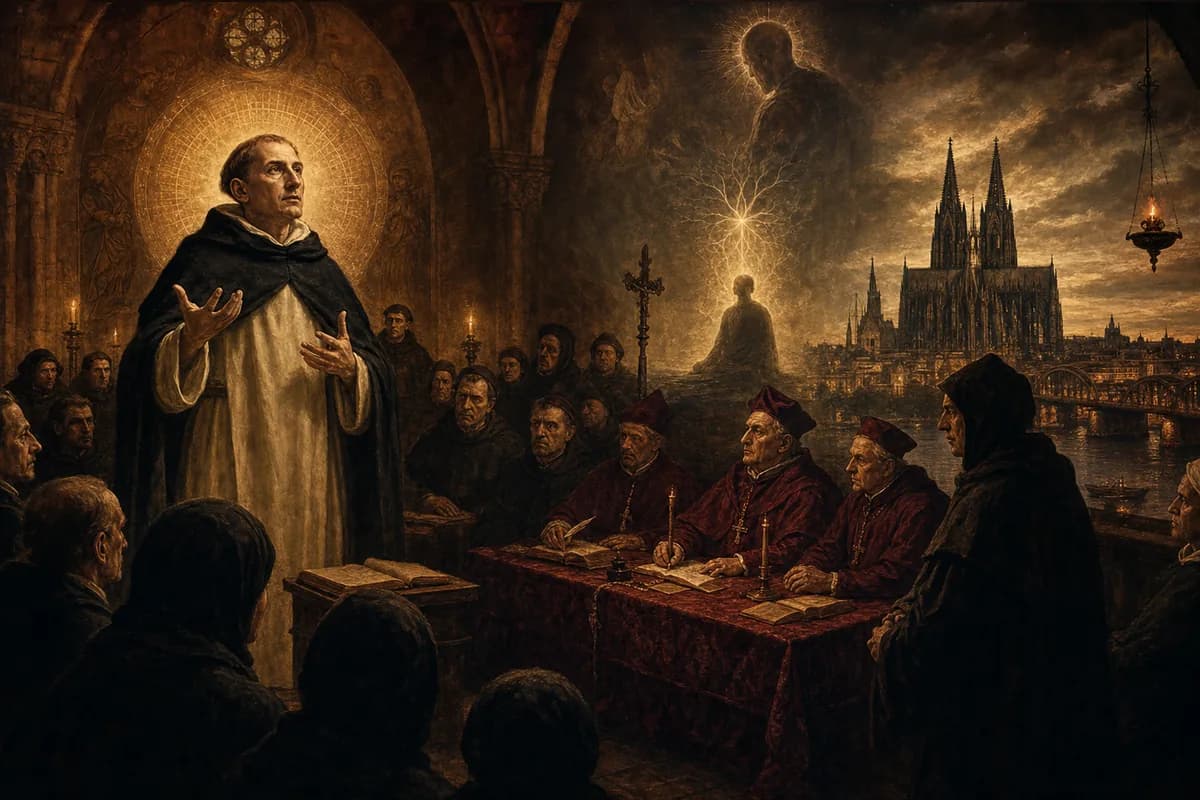
Meister Eckhart preaches detachment in Cologne, ground of soul and ground of God as one, vernacular mysticism on trial.
Become poor in will.

Places

Ideas

Grace & Free WillBeing

Words

“The eye with which I see God is the same eye with which God sees me.”

— Meister Eckhart

Works

The German Sermons

·German

Eckhart's vernacular sermons, preached to ordinary listeners and nuns, where his boldest thought lives: the uncreated spark in the ground of the soul, the birth of God within, and a detachment so complete it wills nothing, not even God. Tried for heresy, they were never forgotten.

Life & Moments

c. 1260 CE

Born in Thuringia

Born in Germany, he rose to be a respected Dominican master at Paris and Cologne.

c. 1310 CE

German Sermons

Preached in the vernacular with startling boldness: in the ground of the soul, God and the soul are not two.

c. 1320 CE

Detachment and the Godhead

Taught that the deepest prayer is to want nothing, even the desire for God, until only the divine ground remains.

1326 CE

Tried for Heresy

His daring German sermons on the union of soul and God brought him before an inquisition; he died before the verdict.

Influence

Influenced by

  • ←
    John Scotus Eriugenamystical tradition

    The Neoplatonic mysticism Eriugena carried into the Latin West flows toward the speculative mysticism of Eckhart.

  • ←
    Gregory of Nyssaapophatic mysticism (via Pseudo-Dionysius)

    Gregory's idea that the soul's approach to an infinite God has no final stopping point fed, through the later writer known as Pseudo-Dionysius, into the mystical tradition Eckhart inherited — the sense that the divine is reached less by knowing more than by unknowing.

Related Thinkers

Portrait of John Scotus Eriugena

John Scotus Eriugena

c. 815 CE – c. 877 CE

Portrait of Gregory of Nyssa

Gregory of Nyssa

c. 335 CE – c. 395 CE

Read the Journey →Compare with John Scotus Eriugena

Atlas of Thinkers

A story-first philosophy atlas. Explore history's greatest thinkers through place, time, movement, and ideas.

Explore

  • Thinkers
  • Atlas
  • Works

Browse

  • Concepts
  • Volumes

About

  • About the Atlas
  • Image Credits

Volume I · Ancient Greece · 624-262 BCE