Atlas of Thinkers
ThinkersAtlasTimelineWorksBlog

Atlas of Thinkers

A story-first philosophy atlas. Explore history's greatest thinkers through place, time, movement, and ideas.

Explore

  • Thinkers
  • Atlas
  • Works

Browse

  • Concepts
  • Volumes

About

  • About the Atlas
  • Image Credits

Volume I · Ancient Greece · 624-262 BCE

Atlas of Thinkers
ThinkersAtlasTimelineWorksBlog
  1. Home
  2. /Thinkers
  3. /John Scotus Eriugena
Portrait of John Scotus Eriugena

John Scotus Eriugena

MedievalMystic

Born c. 815 CE, Dublin

Died c. 877 CE

The lone genius of the dark centuries, who read Greek when almost no one in the West could, and dared to fold God and creation into a single nature.

An Irish scholar at the court of Charles the Bald, Eriugena was the most original mind in Europe for three hundred years on either side of him. Knowing Greek, he translated the mystical Dionysius and absorbed a Neoplatonism no one else in the Latin West could reach. His Periphyseon divides all reality into a single unfolding Nature: God as uncreated creator, the eternal causes, the created world, and God again as the end to which all returns. It was too bold for its age — condemned centuries later as pantheism — but it remains one of the great speculative systems, written in a desert of learning.

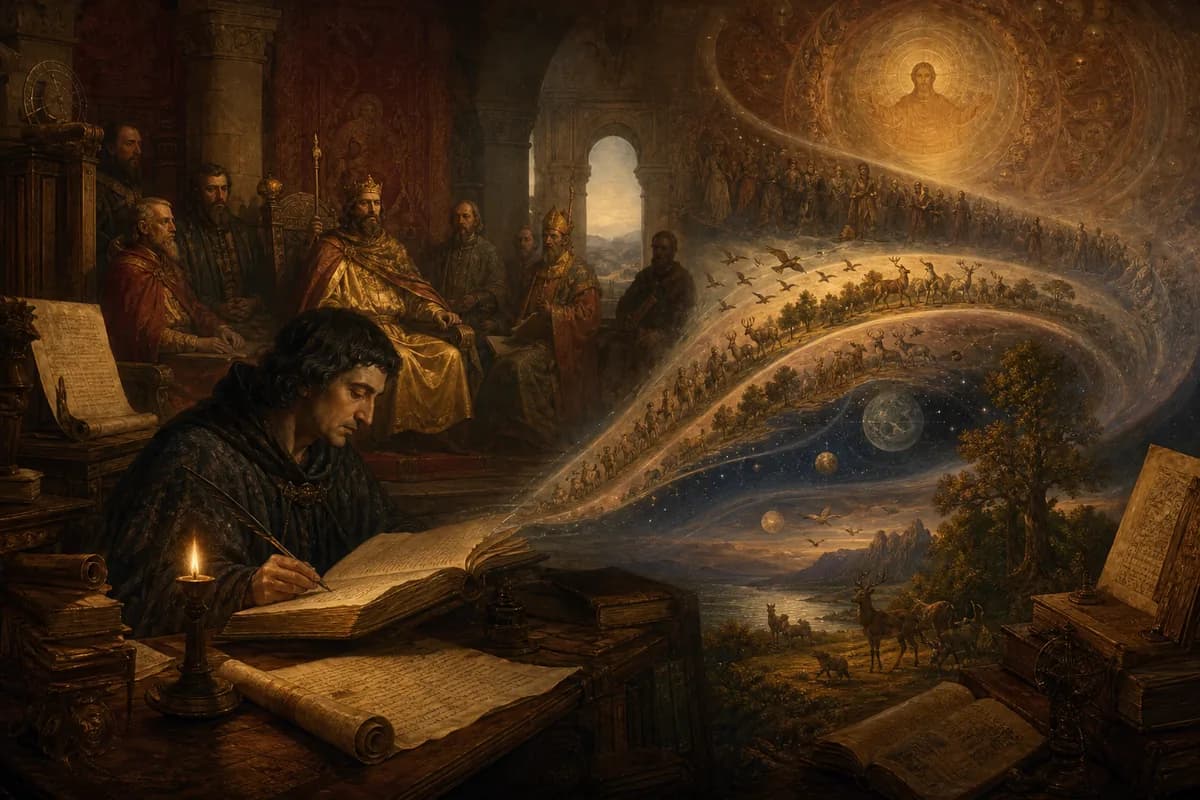
Eriugena at the Carolingian court writes the Periphyseon, God and creation as one unfolding nature, Greek manuscripts rare.
Nature unfolds and returns.

Places

Ideas

NatureBeing

Words

“We do not know what God is. God himself does not know what he is, because he is not any thing.”

— John Scotus Eriugena

Works

Periphyseon

·Latin

Eriugena's vast dialogue dividing all reality into a single Nature in four aspects: God as uncreated creator, the eternal causes, the created world, and God again as the end to which all things return. A Neoplatonic system of astonishing boldness, written in an age that could barely read its sources.

Life & Moments

c. 815 CE

Born in Ireland

Born in Ireland when the Latin West had almost lost Greek. He would become the most original mind in Europe for three hundred years on either side.

c. 845 CE

At the Carolingian Court

Joined the court of Charles the Bald, the rare place in early medieval Europe where Greek learning could survive.

c. 860 CE

Translating Dionysius

Translated the mystical Dionysius from Greek into Latin, bringing Neoplatonism to a West that could barely reach it.

c. 867 CE

The Periphyseon

Completed his great system folding God and creation into a single unfolding nature, too bold for its age.

Influence

Influenced

  • →
    Meister Eckhartmystical tradition

    The Neoplatonic mysticism Eriugena carried into the Latin West flows toward the speculative mysticism of Eckhart.

  • →
    Nicholas of Cusanegative theology anticipated

    Eriugena's insistence that God exceeds every category the intellect can apply to him directly prefigures Cusa's learned ignorance, and Cusa owned and annotated copies of Eriugena's work.

Related Thinkers

Portrait of Meister Eckhart

Meister Eckhart

c. 1260 CE – c. 1328 CE

Portrait of Nicholas of Cusa

Nicholas of Cusa

1401 CE – 1464 CE

Read the Journey →Compare with Meister Eckhart

Atlas of Thinkers

A story-first philosophy atlas. Explore history's greatest thinkers through place, time, movement, and ideas.

Explore

  • Thinkers
  • Atlas
  • Works

Browse

  • Concepts
  • Volumes

About

  • About the Atlas
  • Image Credits

Volume I · Ancient Greece · 624-262 BCE