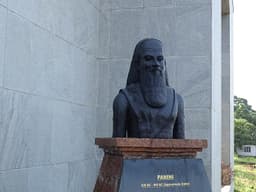
Panini
He wrote the most complete grammar of any language in the ancient world. Four thousand rules, no exceptions, total precision.
Panini lived in Gandhara (modern Pakistan/Afghanistan) and composed the Ashtadhyayi, a grammar of Sanskrit in roughly 4,000 rules. It is the earliest known work of descriptive linguistics and one of the greatest intellectual achievements of the ancient world. His method of analysis, using metalanguage and formal rules, anticipated modern computational linguistics by over two thousand years. Noam Chomsky called it the most complete generative grammar of any language ever written.

Places
Ideas
Words
“In the beginning was the word, and the word was grammar.”
Works
Life & Moments
Born in Gandhara
Born in Shalatula, a town in the Gandhara region of what is now northwestern Pakistan. Little is known of his life beyond his birthplace and his work. He may have studied at Takshashila, one of the oldest universities in the world.
Study at Taxila
By tradition he studied at Taxila, one of the oldest universities in the world, where the precision of Sanskrit grammar was already a living discipline waiting to be formalized.
Composes the Ashtadhyayi
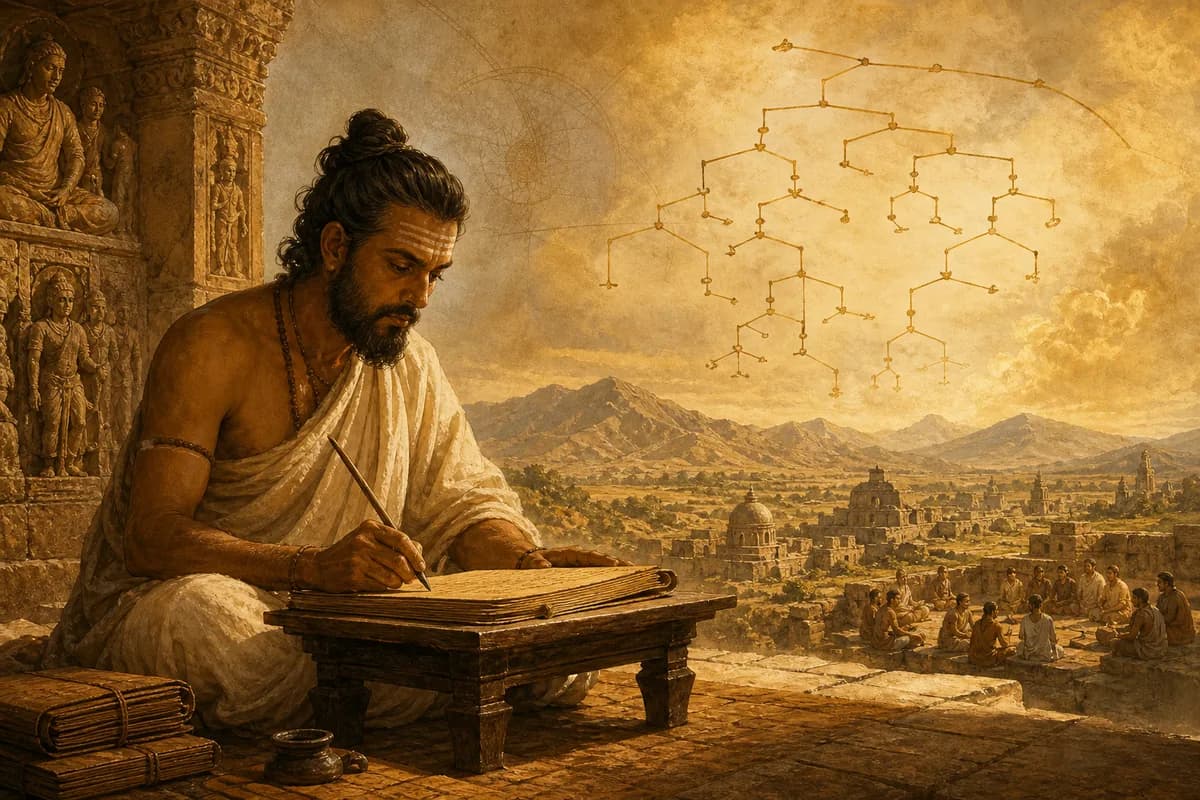
Panini produced a grammar of Sanskrit in roughly four thousand rules, organized with a precision that modern linguists compare to a programming language. The Ashtadhyayi is not just a grammar book. It is a formal system, arguably the first in human history, that generates every valid sentence in a language from a finite set of rules.
Grammar as Formal System
The Ashtadhyayi became the standard for Sanskrit and a model of rule-based analysis. Two millennia later, linguists would call it the first generative grammar.
Influence
Influenced
- Bhartrhari
Bhartrhari's Vakyapadiya begins from Panini's grammar and asks what it implies about reality. He argued that language is not a tool laid over the world but the medium in which anything can be known at all.
- Noam Chomsky
Chomsky has repeatedly named Panini's grammar as the earliest generative grammar: a finite system of ordered rules producing every well-formed sentence of a language, written more than two thousand years before the idea reappeared.

