Fragments
What survives of Heraclitus
Nothing Heraclitus wrote survives complete. These 14 lines reached us only because later writers copied them into works of their own, usually while arguing about something else.
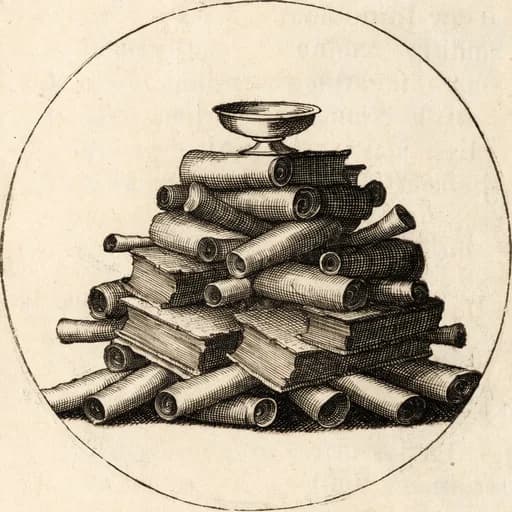
The Fragility of Ancient Papyrus
None of the early Greek philosophers left manuscripts that survived antiquity. Their prose books and philosophical poems disappeared into the dust of Mediterranean library fires, political upheavals, and decay. The few sentences we possess today survived solely because later commentators—from Aristotle and Simplicius to Diogenes Laërtius and Sextus Empiricus—quoted them while writing treatises of their own centuries later.
DK 22 B1, Wording likely his
Sextus Empiricus, Against the Logicians VII.132 (c. 200 CE)
A sceptic surveying what earlier thinkers had claimed about the criterion of truth. He copied out the opening of the book as evidence in an argument that no such criterion exists.
DK 22 B12, Wording likely his
Arius Didymus, quoted in turn by Eusebius, Preparation for the Gospel XV.20.2 (c. 315 CE)
Arius Didymus was compiling opinions about the soul; three centuries later Eusebius quoted that compilation while arguing that Greek philosophy pointed beyond itself. The line reaches us at two removes.
DK 22 B91, Wording disputed
Plutarch, On the E at Delphi 392b (c. 100 CE)
Plutarch was writing about the letter E carved at Delphi and turned to Heraclitus to argue that mortal things never hold still long enough to be said to exist.
DK 22 B53, Wording likely his
Hippolytus of Rome, Refutation of All Heresies IX.9.4 (c. 222 CE)
Hippolytus was trying to destroy the reputation of a heretic named Noetus by showing his theology had been lifted from a pagan Greek. To make the charge stick he quoted Heraclitus at length and accurately.
DK 22 B54, Wording likely his
Hippolytus of Rome, Refutation of All Heresies IX.9.5 (c. 222 CE)
Quoted in the same attack on Noetus, a line later in the same passage.
DK 22 B60, Wording likely his
Hippolytus of Rome, Refutation of All Heresies IX.10.4 (c. 222 CE)
Cited as evidence that Heraclitus held opposites to be identical, which was exactly the doctrine Hippolytus wanted to pin on his heretic.
DK 22 B62, Wording likely his
Hippolytus of Rome, Refutation of All Heresies IX.10.6 (c. 222 CE)
Produced as the clearest proof of the identity of opposites, and so the most damning parallel to the heresy under attack.
DK 22 B93, Wording likely his
Plutarch, On the Oracles at Delphi 404d (c. 100 CE)
Plutarch was a priest at Delphi, arguing about why the god had stopped answering in verse. He reached for a line written six centuries earlier about how that god communicates at all.
DK 22 B101, Wording likely his
Plutarch, Against Colotes 1118c (c. 100 CE)
Quoted while defending earlier philosophers against an Epicurean who had mocked them, as proof that enquiry could begin from the self.
DK 22 B119, Wording likely his
Stobaeus, Anthology IV.40.23 (c. 450 CE)
Stobaeus was assembling an anthology of instructive passages for the education of his son. The line survives because it looked useful to a father.
DK 22 B123, Wording likely his
Themistius, Orations 5.69b (c. 360 CE)
A court orator used it in a speech, nine centuries after it was written, as a compact way of saying that truth does not present itself.
DK 22 B40, Wording likely his
Diogenes Laertius, Lives of the Eminent Philosophers IX.1 (c. 230 CE)
A biographer needed a line to establish his subject's famous contempt for other people's erudition, and quoted the insult itself.
DK 22 B30, Wording likely his
Clement of Alexandria, Miscellanies V.104.1 (c. 200 CE)
Clement was arguing that Greek thinkers had glimpsed in fragments what scripture set out whole. To show the glimpse he had to reproduce it.
DK 22 B45, Wording likely his
Diogenes Laertius, Lives of the Eminent Philosophers IX.7 (c. 230 CE)
Included in the biographical sketch as a specimen of the obscurity that earned him the nickname the Riddler.
Heraclitus
(c. 535 BCE – c. 475 BCE)Heraclitus wrote in riddles and refused to explain them. He believed the universe is a process, not a thing, an eternal fire that kindles and goes out in measure. Opposites need each other. Day defines night. War fathers peace. The logos holds it all together, but most people walk through life asleep to it. He was difficult, solitary, and possibly the most original thinker before Socrates.
Philosophical Clash
Heraclitus vs. Parmenides
Eternal Flux vs. Changeless Being: Does everything change, or is change an illusion?
Quotes & Sayings by Heraclitus
“No man ever steps in the same river twice, for it is not the same river and he is not the same man.”
“The road up and the road down are one and the same.”