Fragments
What survives of Parmenides
Nothing Parmenides wrote survives complete. These 7 lines reached us only because later writers copied them into works of their own, usually while arguing about something else.
The Fragility of Ancient Papyrus
None of the early Greek philosophers left manuscripts that survived antiquity. Their prose books and philosophical poems disappeared into the dust of Mediterranean library fires, political upheavals, and decay. The few sentences we possess today survived solely because later commentators—from Aristotle and Simplicius to Diogenes Laërtius and Sextus Empiricus—quoted them while writing treatises of their own centuries later.
DK 28 B1, Wording likely his
Sextus Empiricus, Against the Logicians VII.111 (c. 200 CE)
The same sceptic who preserved Heraclitus's opening also copied out the proem of Parmenides, again as material for an argument about how anyone could claim to know anything.
DK 28 B2, Wording likely his
Proclus, Commentary on Plato's Timaeus I.345 (c. 440 CE)
A Neoplatonist reading Plato reached back nine centuries for the lines that first set out the choice between being and not-being.
DK 28 B3, Wording disputed
Clement of Alexandria, and again by Plotinus, Miscellanies; Enneads VI.23; V.1.8 (c. 200 and c. 260 CE)
Quoted independently by a Christian apologist and by the founder of Neoplatonism, who read it as an anticipation of his own doctrine that thought and being coincide.
DK 28 B6, Wording likely his
Simplicius, Commentary on Aristotle's Physics 86.27 (c. 540 CE)
Simplicius was explaining a passage of Aristotle and quoted the original to show that Aristotle had reported it fairly.
DK 28 B8, Wording likely his
Simplicius, Commentary on Aristotle's Physics 145.1 (c. 540 CE)
Simplicius wrote that he was transcribing these verses at length because copies of Parmenides's book had become scarce. He was right to worry; his commentary is now the reason we have them.
DK 28 B16, Wording likely his
Aristotle, and separately Theophrastus, Metaphysics; On the Senses 1009b21; 3 (c. 340 and c. 320 BCE)
Aristotle quoted it while arguing that earlier thinkers had confused thought with bodily states, and his pupil Theophrastus quoted it again in a survey of theories of perception.
DK 28 B19, Wording likely his
Simplicius, Commentary on Aristotle's On the Heavens 558.9 (c. 540 CE)
Quoted as the closing lines of the section on mortal opinion, to mark where the poem ended.
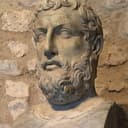
Parmenides
(c. 515 BCE – c. 450 BCE)Where Heraclitus saw flux, Parmenides saw permanence. In a single philosophical poem, he argued that change, motion, and multiplicity are impossible, that only Being exists, whole and unchanging. The argument sounds absurd, but it forced every thinker after him to account for it. Plato revered him. Aristotle wrestled with him. The problem of Being has never gone away.
Philosophical Clash
Heraclitus vs. Parmenides
Eternal Flux vs. Changeless Being: Does everything change, or is change an illusion?
Quotes & Sayings by Parmenides
“What is, is. What is not, cannot be.”
“It is the same thing that can be thought and that can be.”