Place
Baghdad
Capital of the Abbasid caliphate and the intellectual center of the medieval world. The House of Wisdom here translated the entire Greek philosophical corpus into Arabic, launching a golden age of science and philosophy.
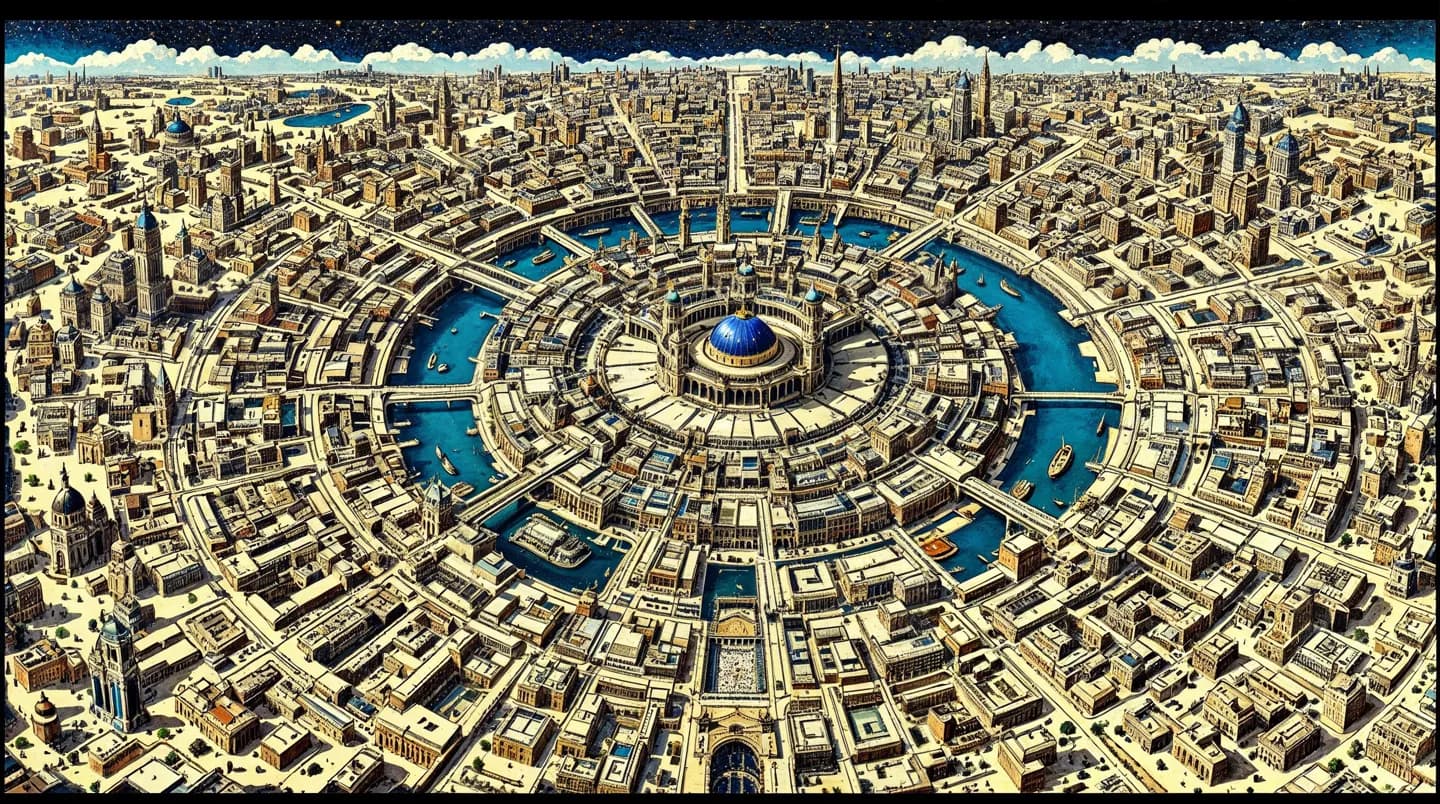
Baghdad was built from scratch in 762 CE by the Abbasid caliph al-Mansur, a perfect circle of administrative buildings and canals on the Tigris. Within a generation it was the largest city in the world outside China. The caliphs funded translators to render Greek, Persian, and Indian texts into Arabic: Plato, Aristotle, Galen, Euclid, all of it. The institution that housed this work is called the House of Wisdom, Bayt al-Hikma, though historians debate exactly what kind of place it was. What is not in doubt is the output: centuries of commentary, synthesis, and original work in mathematics, medicine, optics, and philosophy. Al-Kindi, al-Farabi, and later Ibn Rushd all worked in this tradition. The Mongols sacked the city in 1258, throwing books into the Tigris until the river ran dark.
Thinkers Connected to Baghdad

Al-Kindi
The Philosopher of the Arabs. He opened the door between Greek thought and the Islamic world, and walked through it first.

Al-Farabi
The Second Teacher (after Aristotle). He mapped out the perfect city and placed the philosopher at its head.

Al-Ghazali
He held the most prestigious teaching post in the Islamic world, then abandoned it. Philosophy had failed him. Only direct experience of God would do.

Al-Razi
A physician who trusted observation over authority, and reason over revelation, further than almost anyone of his age dared.

Al-Ash'ari
The theologian who turned against his own teachers to argue that reason must serve revelation, founding the school that became Sunni orthodoxy.