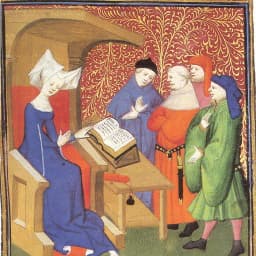
Christine de Pizan
Widowed at twenty-five with three children and no income, she became Europe's first known woman to earn her living by writing, and used that living to argue, book after book, that women's supposed inferiority was a slander invented by men.
Christine de Pizan was raised at the French royal court, where her Italian father served as astrologer and physician to Charles V and, unusually for the time, encouraged his daughter's education. Widowed young when her husband died in an epidemic, left with three children, a mother, and a niece to support, and denied money owed to her husband's estate by a legal system stacked against widows, she turned professional writer out of practical necessity, producing poetry, biography, and political and moral treatises for aristocratic patrons in a career that made her, so far as surviving records show, the first woman in Europe to support herself entirely by her pen. Her most influential work, The Book of the City of Ladies, responds directly to a long medieval literary tradition of misogynist writing, most pointedly Jean de Meun's continuation of the Romance of the Rose, by staging an allegorical vision in which three virtues, Reason, Rectitude, and Justice, help her construct a symbolic city built from the stories of virtuous, capable, and intelligent women throughout history, refuting one inherited slander against women at a time with a counter-example. Her argument was not that women and men are identical, but that women's apparent intellectual and moral inferiority reflects a lack of education and opportunity rather than any lack of natural capacity, a distinction that let her mount a sustained, systematic case against misogyny without needing to claim more than the evidence of history already supported. She engaged directly and publicly in the literary quarrel over the Romance of the Rose, trading formal written arguments with prominent university theologians in a debate that survives, unusually for a medieval woman writer, in her own words rather than only through hostile summary. She spent her final years in a convent at Poissy during the chaos of civil war and English occupation, and her last known work, written in 1429, celebrates Joan of Arc as proof that God could still work through a woman when men had failed.

Places
Ideas
Words
“If it were customary to send little girls to school and teach them the same subjects as boys, they would learn just as thoroughly.”
“All evils which are in the world come from women, so certain men claim. Yet there are many good women, and this can be proved.”
Works
Life & Moments
Debates the Quarrel of the Rose
Pizan engaged prominent university theologians in a formal written debate over Jean de Meun's misogynist continuation of the Romance of the Rose: a dispute that survives, unusually for a medieval woman writer, in her own words.
Writes The Book of the City of Ladies
Responding to a long tradition of misogynist literature, Pizan staged an allegorical city built from the stories of virtuous and capable women, arguing that women's apparent inferiority reflected lack of education rather than lack of capacity.
Influence
Influenced by
- Augustine
The City of Ladies takes its architecture from Augustine's City of God, raising a walled city of women's achievements against the accumulated slanders of the learned, one biography laid as a stone at a time.
- Boethius
Christine's allegory, in which personified virtues visit a despairing writer and reason her out of received opinion, follows the pattern Boethius set when Lady Philosophy came to his prison cell.
Influenced
- Mary Wollstonecraft
Three and a half centuries before Wollstonecraft, Pizan had already argued that women's apparent inferiority reflects lack of education rather than lack of natural capacity: the same structural argument Wollstonecraft would make the philosophical center of A Vindication of the Rights of Woman, though no direct textual link between them is documented.


