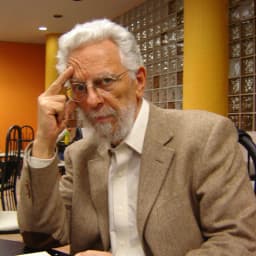
Enrique Dussel
He argued that modernity's self-image as pure reason and progress depends on hiding the violence it inflicted on everyone outside Europe, and called for a philosophy that starts from the perspective of the excluded instead.
Dussel trained in Europe, in Freiburg and Paris, in the same phenomenological tradition that shaped much of twentieth-century continental philosophy, then carried its tools home to Latin America and turned them against the very civilization that had produced them. His concept of transmodernity holds that modernity is not the universal, neutral achievement of reason it presents itself as, but a story Europe tells about itself that depends on erasing the conquest, slavery, and extraction that made European wealth and self-confidence possible in the first place: 1492 belongs at the center of the story of modernity, not its margins. Working alongside economists and theologians, he helped found the philosophy of liberation, a movement built on a basic reversal: instead of theorizing justice from the perspective of an already-comfortable center and extending charity outward, start philosophy from the position of the poor, the colonized, the excluded, the ones a system's violence normally makes invisible to itself. A priest turned into a political target during Argentina's military dictatorship, he survived a bomb attack on his home in 1973 and spent years in exile in Mexico, where he wrote most of his major work and helped build one of Latin America's most influential schools of thought.

Places
Ideas
Words
“Modernity is not a strictly European phenomenon, but a European-Amerindian phenomenon.”
“The Other is not just another self; it is the one whose suffering the system does not see.”
Works
Life & Moments
Survives a bomb attack during Argentina's dictatorship
A priest turned political target for his writing, Dussel survived a bomb attack on his home during Argentina's military dictatorship and spent years afterward in exile in Mexico, where he wrote most of his major work.
Publishes The Invention of the Americas
Dussel reframed 1492 as the founding act of modernity itself, arguing that Europe's self-understanding as rational and universal depended on hiding the violence of conquest behind a myth of civilizing mission.
Influence
Influenced by
- Karl Marx
Dussel's close readings of Marx's late notebooks, especially the Grundrisse, fed directly into his philosophy of liberation, which extends Marx's critique of exploitation to argue that the wealth of Europe's center depended on the violent extraction of Latin America's periphery.
- Frantz Fanon
Dussel takes from Fanon the insistence that the colonized are not a special case within an otherwise general theory but the place from which the theory has to be rewritten.
- Jürgen Habermas
Dussel argued in a long public exchange that an ethics grounded in what all participants could agree to still assumes participants who are already at the table, and that those excluded from the conversation are the point.


