He was the most celebrated man in the Islamic world, and he could not swallow a single word he said. Al-Ghazali stood before his students in Baghdad, the city's largest lecture hall, and felt his throat close. The words came out, but they were hollow. He had mastered every argument, every proof, every logical demonstration the philosophers had devised. None of it touched the thing he was supposed to be teaching about: God Himself.
He was born in 1058 in Tus, a small city in northeastern Persia, into a family of modest means. His father had been a wool-spinner who died young, but the man left his sons in the care of a Sufi friend, hoping they would learn something beyond survival. Al-Ghazali did. He studied law, theology, philosophy, and rose faster than anyone expected. By his early thirties, the Seljuk vizier Nizam al-Mulk appointed him to the most prestigious teaching post in the Islamic world, the Nizamiyya madrasa in Baghdad. Students traveled from every province to hear him speak. He was the proof of Islam, the living demonstration that reason and revelation could stand together.
But the demonstrations stopped working.
His crisis did not arrive as a sudden storm. It crept in like a low fever. He began reading the works of Ibn Sina and Al-Farabi, the two towering figures of Islamic philosophy, and something felt wrong. They claimed that reason alone could prove the existence of God, the immortality of the soul, the creation of the world. Al-Ghazali followed their arguments carefully. They were brilliant. They were also circular, always slipping a premise in through a back door they pretended did not exist. He wrote The Incoherence of the Philosophers as an act of intellectual surgery, cutting open their system to show where they had hidden their assumptions. They claimed the world was eternal, for example, and that God was the necessary cause behind it, but their arguments for eternity began by assuming eternity. They said the soul was separate from the body and immortal, but their proofs relied on a picture of the soul that they had drawn themselves. Al-Ghazali did not reject philosophy itself. He rejected the claim that philosophy could reach the absolute without a transformation of the person doing the reasoning.
But the crisis was not academic. It was physical. He could not teach. He could not eat. He lost his voice. His throat locked up. For months, he wavered between clinging to his position and throwing it all away. The caliph, the vizier, his students, everyone expected him to stay. He was at the top. There was nothing higher. But he could feel the falseness of his own life like a splinter in his chest.
Then he left.
He resigned his post, distributed his wealth to his family and the poor, and walked out of Baghdad. He went to Damascus, then to Jerusalem, then to the deserts and mosques of Syria and Arabia. He lived as a wandering Sufi for more than ten years. He ate what people gave him. He prayed until his knees went raw. He was not gathering new information. He was trying to burn away everything that stood between him and direct experience of God.
What he found, or what found him, became the basis of his great late work, The Revival of the Religious Sciences. The book is not a system of proofs. It is a map of the inner life: how to purify intention, how to recognize the tricks the ego plays, how to let the presence of God become more real than the arguments for it. He did not discard reason. He placed it inside a larger body: the body of a living person who had been broken open by doubt and rebuilt by something deeper.
Al-Ghazali died in 1111 in his hometown of Tus, back in Persia, where he had returned to teach a small circle of students. He was known by then as the Renewer of the Faith. But what stayed with the people who had seen him before and after his collapse was the look in his eyes. He had stopped trying to prove anything. He had walked down into his own doubt, deeper than arguments could reach, and the man who came back up was not the same man who had stood in the lecture hall in Baghdad.
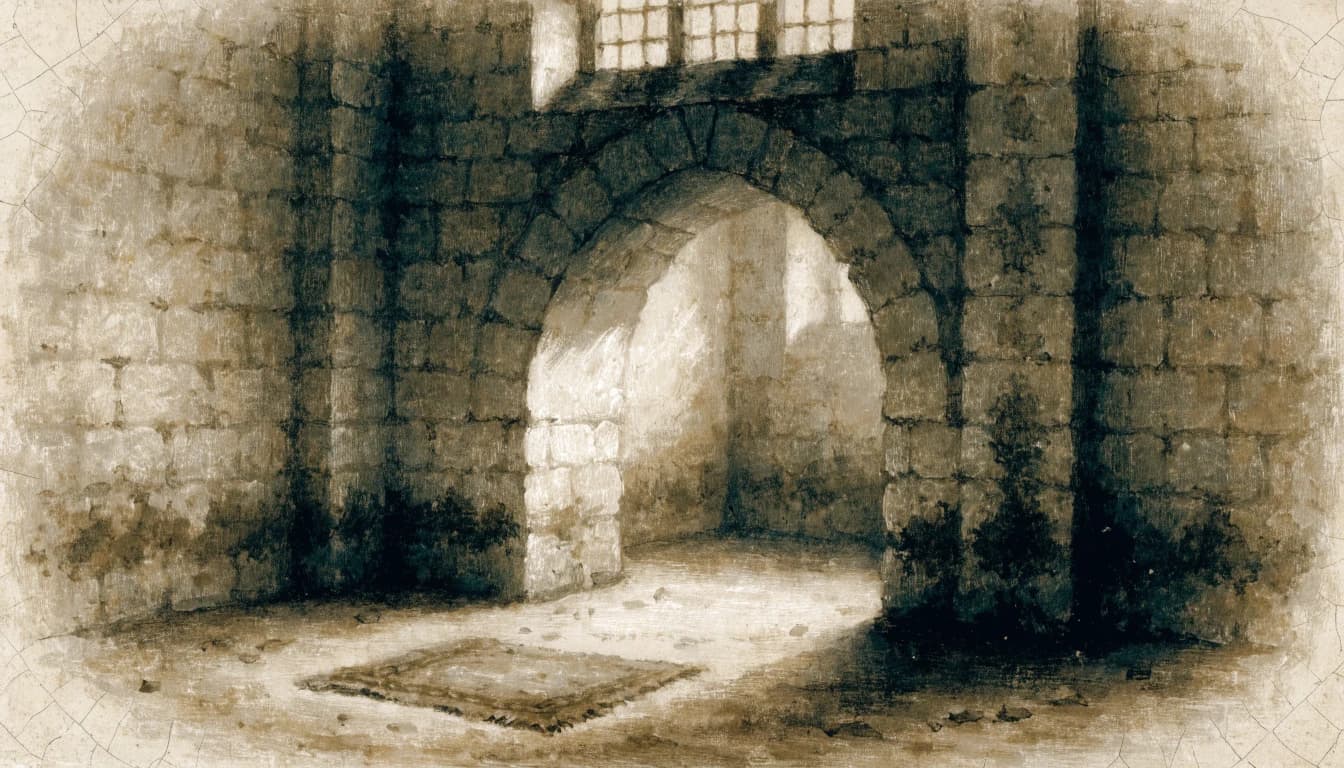
Ibn Sina had built a system of the universe in his mind, a palace of logic. Al-Farabi had described the perfect city. Al-Ghazali left both palaces empty and went to live in a small room with a worn prayer mat, because the thing he was looking for was not a conclusion. It was a stillness that no argument could break.