Fragments
What survives of Empedocles
Nothing Empedocles wrote survives complete. These 8 lines reached us only because later writers copied them into works of their own, usually while arguing about something else.
The Fragility of Ancient Papyrus
None of the early Greek philosophers left manuscripts that survived antiquity. Their prose books and philosophical poems disappeared into the dust of Mediterranean library fires, political upheavals, and decay. The few sentences we possess today survived solely because later commentators—from Aristotle and Simplicius to Diogenes Laërtius and Sextus Empiricus—quoted them while writing treatises of their own centuries later.
DK 31 B17, Wording likely his
Simplicius, Commentary on Aristotle's Physics 158.1 (c. 540 CE)
The same commentator who rescued Parmenides copied out some thirty-five lines here, again while explaining Aristotle to students who no longer had the originals.
DK 31 B6, Wording likely his
Sextus Empiricus, Against the Physicists X.315 (c. 200 CE)
Cited in a catalogue of what earlier thinkers had said the world is made of, as a step in arguing that none of them could be shown to be right.
DK 31 B8, Wording likely his
Plutarch, Against Colotes 1111f (c. 100 CE)
Plutarch was defending the old philosophers against an Epicurean who claimed they had made life impossible to live. He quoted this to show the doctrine was subtler than the caricature.
DK 31 B109, Wording likely his
Aristotle, Metaphysics; On the Soul 1000b6; 404b13 (c. 340 BCE)
Quoted twice, as the clearest statement of the principle that like is known by like, which Aristotle then set about dismantling.
DK 31 B112, Wording likely his
Diogenes Laertius, Lives of the Eminent Philosophers VIII.62 (c. 230 CE)
A biographer collecting the stories that made his subject famous, including the claim to divinity that later got him mocked.
DK 31 B115, Wording likely his
Hippolytus of Rome, and separately Plutarch, Refutation of All Heresies; On Exile VII.29; 607c (c. 222 and c. 100 CE)
Hippolytus used it to argue that a heresy about the soul's fall was borrowed from a pagan poet. Plutarch had quoted the same lines a century earlier to console a friend who had been banished.
DK 31 B117, Wording likely his
Diogenes Laertius, Lives of the Eminent Philosophers VIII.77 (c. 230 CE)
Included in the biography as evidence that Empedocles taught the transmigration of souls.
DK 31 B129, Wording likely his
Porphyry, Life of Pythagoras 30 (c. 280 CE)
Quoted by a biographer of Pythagoras who took the unnamed man of the poem to be Pythagoras himself, and used the lines as testimony from a near contemporary.
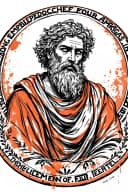
Empedocles
(c. 494 BCE – c. 434 BCE)Empedocles was a poet, healer, and self-proclaimed miracle worker from Acragas in Sicily. He proposed that all matter is composed of four eternal elements mixed and separated by two cosmic forces. Love unites, Strife divides, and the universe cycles between their dominance. He wrote in verse, performed public healings, and according to legend threw himself into Mount Etna. His sandal was found at the rim.
Quotes & Sayings by Empedocles
“There is only mixing and exchange of what is mixed. 'Nature' is only a name given to these things by men.”
“Fire and water and earth and the endless height of air; and cursed Strife apart from these, balanced in every way, and Love among them, equal in length and breadth.”