Milesians
Key Idea
“Nature has a rational order that can be understood through inquiry.”
Overview & Origins
The first school of philosophy. Based in the Ionian city of Miletus, these thinkers sought natural explanations for the world, launching the tradition of rational inquiry. Thales proposed water as the fundamental substance; his successors offered air and the infinite.
The Milesians, emerging in the 6th century BCE in the bustling Ionian city of Miletus, represent the dawn of Western philosophy. Departing from mythological explanations, Thales, Anaximander, and Anaximenes sought to uncover the rational order underlying the cosmos. Thales posited water as the primordial substance, a bold assertion that nature could be understood through observation and reason. Anaximander introduced the concept of the 'apeiron' (the infinite), an indefinite source from which all things arise and return, while Anaximenes proposed air as the fundamental element, emphasizing its transformative properties. These thinkers pioneered the idea that the universe operates according to natural laws accessible to human inquiry, laying the groundwork for scientific and philosophical thought. Their legacy endures as a testament to the power of rational exploration, marking a pivotal shift from mythos to logos.
Core Tenets
Primordial Substance
The Milesians believed that all things originate from a single, fundamental substance, such as water, air, or the infinite.
Rational Order
They asserted that the universe operates according to a rational, comprehensible order, accessible through inquiry.
Natural Explanation
Rejecting mythological accounts, they sought to explain phenomena through natural principles and observable processes.
Philosophers of this Tradition

Thales
The first philosopher. He looked at the world and asked what it was made of.
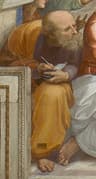
Anaximander
Thales asked what the world is made of. Anaximander answered: nothing you can name. The origin is the boundless.

Anaximenes
Everything is air, thickening and thinning. The first attempt to explain change by a single measurable process.
Canonical Works
Thales is said to have predicted the solar eclipse of 585 BCE and to have measured the height of the pyramids by their shadows. These accounts, preserved by Herodotus and others, made him the first figure where science meets philosophy.
Thales wrote nothing that survives. What we know comes from later authors (Aristotle, Diogenes Laertius, and others) who preserved fragments of his thought on water, the soul, and the divine.
The lost prose treatise, possibly the first in the Greek tradition, in which Anaximander set out the boundless as the origin of all things and described a cosmos governed by necessity. Only a single sentence survives, quoted by later writers.
Anaximenes' account of how air, by condensing and thinning, becomes wind, cloud, water, earth, and stone. Surviving only in fragments and later reports, it is the first attempt to explain qualitative change through a single measurable process.
Centers of Thought
Voices & Maxims
“Water is the first principle of all things.”
“Know thyself.”
“From what things existing things come to be, into these they pass away according to necessity; for they pay the penalty to one another for their injustice according to the ordering of time.”
“The earth hangs free, held up by nothing, remaining in place because it is equally distant from all things.”