Peripatetics
Key Idea
“Understanding comes from observation, classification, and careful reasoning.”
Overview & Origins
Aristotle's school at the Lyceum, named for the covered walkway (peripatos) where he taught. The Peripatetics were empirical, systematic, and wide-ranging: contributing to biology, logic, ethics, politics, and literary criticism. Where Plato looked up to the Forms, Aristotle looked around at the world.
The Peripatetic school, founded by Aristotle in 335 BCE at the Lyceum, emerged as a revolutionary departure from Platonic idealism. Named for the covered walkway (peripatos) where Aristotle taught, the school championed empirical observation and systematic analysis as the foundations of knowledge. Unlike Plato, who sought truth in transcendent Forms, Aristotle insisted on studying the tangible world, meticulously classifying natural phenomena and human institutions. His method—grounded in logic, biology, ethics, and politics—aimed to uncover the underlying principles of reality through careful reasoning. The Peripatetics' enduring legacy lies in their holistic approach, bridging speculative philosophy with practical inquiry. Their work laid the groundwork for Western scientific and philosophical traditions, influencing thinkers from Aquinas to modern empiricists. Aristotle's Lyceum became a beacon of intellectual rigor, where understanding was not deduced from abstract ideals but cultivated through patient observation and dialectical precision.
Core Tenets
Empiricism
Knowledge derives from sensory experience and systematic observation of the natural world.
Teleology
All things have inherent purposes or ends (telos), which explain their development and function.
Golden Mean
Virtue lies in balancing extremes, achieving harmony through rational moderation in ethics and action.
Philosophers of this Tradition

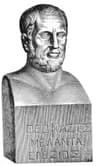
Canonical Works
Aristotle's most important work on ethics. Argues that happiness (eudaimonia) is the highest good, achievable through a life of virtue and the cultivation of practical wisdom.
A collection of treatises on first philosophy: the study of being as being, substance, causation, and the unmoved mover.
A systematic study of the state, citizenship, and constitutions. Famous for declaring that humans are by nature political animals.
The earliest surviving work of dramatic theory. Defines tragedy, introduces catharsis, and argues that poetry is more philosophical than history.
Thirty short sketches of human types (the flatterer, the chatterbox, the penny-pincher, the man of petty ambition), each drawn in a few precise, witty strokes. The first work of character writing, it shaped comedy and the essay for two thousand years.
Core Ideas & Concepts
Voices & Maxims
“We are what we repeatedly do. Excellence, then, is not an act, but a habit.”
“Knowing yourself is the beginning of all wisdom.”
“It is the mark of an educated mind to be able to entertain a thought without accepting it.”
“Time is the most valuable thing a person can spend.”