Roman Eclectics
Key Idea
“Take from every school what seems most reasonable, and distrust those who claim certainty.”
Overview & Origins
Cicero had no single school; he selected from Plato, Aristotle, the Stoics, and the Skeptics, asking always which view was most probable. His goal was to make Greek philosophy available to Rome and useful to the statesman. The Latin words he coined ('quality', 'morality', 'appetite') still shape how we think about ethics today.
The Roman Eclectics, epitomized by Cicero, emerged during the late Roman Republic (106-43 BCE) as a philosophical movement characterized by its deliberate avoidance of dogmatism. Cicero, a statesman and orator, sought to synthesize the most compelling ideas from Greek philosophy—Plato’s idealism, Aristotle’s empiricism, Stoic ethics, and Academic Skepticism—into a coherent framework suited to Roman pragmatism. His approach was not to champion a single doctrine but to evaluate each school’s claims probabilistically, asking which views were most reasonable and useful for public life. Metaphysically, the Eclectics were agnostic, distrusting absolute certainty; ethically, they emphasized practical wisdom, civic virtue, and the cultivation of moral character. Cicero’s Latin translations and neologisms, such as 'qualitas' (quality) and 'moralitas' (morality), bridged Greek thought with Roman governance, leaving an indelible mark on Western philosophy. His legacy endures in the tradition of intellectual humility and the adaptive application of ideas to real-world challenges.
Core Tenets
Probabilistic Synthesis
Adopt the most plausible ideas from diverse schools, rejecting dogmatic allegiance to any single system.
Practical Wisdom
Prioritize philosophy’s utility in civic life, emphasizing ethics that serve the statesman and society.
Intellectual Humility
Distrust claims to absolute certainty, favoring reasoned doubt and open inquiry.
Philosophers of this Tradition

Cicero
He translated Greek philosophy into Latin and into politics. Rome's greatest orator was also its most restless thinker.

Philo of Alexandria
The Jewish philosopher who read the Torah through Greek eyes and gave the West its idea of the Logos as the bridge between God and world.
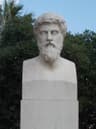
Plutarch
He believed character is destiny, and proved it by writing the lives of famous men side by side.
Canonical Works
Five books of philosophical dialogue set at Cicero's villa in Tusculum. They tackle the fear of death, the endurance of pain, grief, the passions, and whether virtue alone is sufficient for happiness.
A treatise on moral obligation addressed to his son Marcus. The most copied philosophical text of the Middle Ages. It asks: when duty and advantage seem to conflict, which should win?
Philo's allegorical reading of Genesis, in which the six days of creation become a philosophical account of how the divine Logos frames an ordered cosmos. The work fuses the God of Moses with the reason of the Greeks and supplies a vocabulary that Christian theology would inherit whole.
Biographies pairing a famous Greek with a famous Roman, written to illuminate character rather than to chronicle events. Plutarch believed a single jest or gesture could reveal a soul more truly than a won battle.
The essays Plutarch wrote when he was not writing lives: on education, on anger, on talkativeness, on how to tell a friend from a flatterer. Practical, discursive, and full of examples, they were read for centuries as a manual for conducting oneself well.
Core Ideas & Concepts
Voices & Maxims
“The life of the dead is placed in the memory of the living.”
“A room without books is like a body without a soul.”
“The Logos is the image of God, and through it the whole world was framed.”
“The mind is not a vessel to be filled, but a fire to be kindled.”