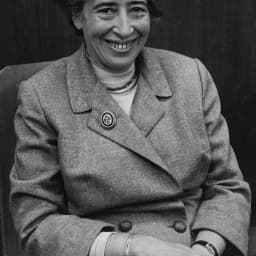
Hannah Arendt
She watched a Nazi bureaucrat testify at his trial and understood something terrible: evil does not require monsters.
Arendt fled Germany after 1933, spent years stateless in Paris, and eventually arrived in New York, where she became the most important political thinker of the century. Her Origins of Totalitarianism traced the logic of Nazi and Stalinist terror: the destruction of the human capacity for plurality, the reduction of people to superfluous things. Her Human Condition recovered the ancient distinction between labor, work, and action, action being the distinctly human capacity to begin something new in the world. Her report on the Eichmann trial in Jerusalem gave us a phrase she did not quite use as a title: the banality of evil. Eichmann was not a monster but a functionary who had stopped thinking. Thinking, she argued, is the one activity that makes cruelty impossible. She made it the subject of her last book, still unfinished when she died at her typewriter in 1975.


Places
Ideas
Words
“There are no dangerous thoughts; thinking itself is dangerous.”
“The smallest act in the most limited circumstances bears the seed of the same boundlessness, because one deed, and sometimes one word, suffices to change every constellation.”
Works
Life & Moments
Eighteen years as a stateless person
When Arendt fled Germany in 1933, she became stateless: without citizenship, a person whom no state was bound to protect. She remained stateless until 1951, when she became an American citizen. The experience shaped everything she wrote: her insistence that rights require belonging to a political community was built from memory.
Eichmann in Jerusalem and the banality of evil
Covering the Eichmann trial for The New Yorker in 1961, Arendt argued that Eichmann was not a monster but an ordinary bureaucrat, a man who had ceased to think. Her phrase 'the banality of evil' provoked an enormous controversy, especially among Jewish intellectuals, and has not settled since. The book was published in 1963.
Influence
Influenced by
- Martin Heidegger
Arendt studied with Heidegger in Marburg in 1924-25. Their relationship was personal and intellectual. She took his analysis of publicness and authenticity and turned it toward politics and plural human action, where he had left a gap.
Influenced
- Jürgen Habermas
Arendt's analysis of the political realm as the space of appearance, argument, and plural action is a central source for Habermas's theory of communicative rationality and the public sphere.

