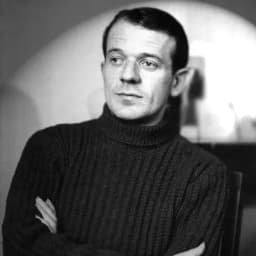
Gilles Deleuze
He treated concepts as tools to be built and used rather than truths to be discovered, and spent a career arguing that difference, not sameness, is what reality is actually made of.
Deleuze made his early reputation writing unusual, sympathetic studies of philosophers the mainstream French curriculum treated as marginal (Hume, Spinoza, Nietzsche, Bergson), reading each of them against the grain of the rationalist tradition to build a philosophy that privileged difference, multiplicity, and becoming over sameness, unity, and fixed being. Difference and Repetition, his most demanding solo work, argued that Western philosophy had a long habit of treating difference as a secondary, derivative fact about things that are fundamentally identical to themselves, and tried to reverse the order: identity itself, he argued, is a temporary, produced effect of more fundamental differences constantly repeating and varying. His collaboration with the radical psychoanalyst Félix Guattari produced Anti-Oedipus and A Thousand Plateaus, two volumes united under the title Capitalism and Schizophrenia, which attacked Freudian psychoanalysis for squeezing the whole restless productivity of human desire into one small, domestic drama about mommy, daddy, and the analyst's couch, and proposed instead a model of thought as a rhizome: a networked, non-hierarchical structure like crabgrass or fungus, with no single root and no fixed center, that could be entered from any point and connect to anything else. He famously said that a concept is a brick, and you can build a courthouse of reason with it or throw it through a window, and his own concepts were built to travel well outside philosophy departments, into film theory, art criticism, and radical politics. He suffered from severe, worsening respiratory illness for the last decades of his life, requiring surgery that removed part of a lung, and when the illness finally became unbearable, he ended his own life by jumping from the window of his Paris apartment.

Places
Ideas
Words
“A concept is a brick. It can be used to build a courthouse of reason. Or it can be thrown through the window.”
“A rhizome has no beginning or end; it is always in the middle, between things, interbeing, intermezzo.”
Works
Life & Moments
Publishes Anti-Oedipus with Guattari
Deleuze and the radical psychoanalyst Félix Guattari published Anti-Oedipus, attacking Freudian psychoanalysis for reducing the productivity of human desire to a small domestic drama, and proposing a new model of thought as a networked rhizome.
Dies by suicide after decades of illness
After decades of severe, worsening respiratory illness including surgery that removed part of a lung, Deleuze ended his own life by jumping from the window of his Paris apartment.
Influence
Influenced by
- Friedrich Nietzsche
Deleuze's early book Nietzsche and Philosophy reread Nietzsche against the dominant rationalist tradition to build a philosophy privileging difference and becoming over sameness and fixed being, a foundation his entire later work built upon.
- Spinoza
Deleuze's Expressionism in Philosophy: Spinoza treated Spinoza's single, univocal substance as a model for thinking about reality without transcendent hierarchy, an idea that runs through all of Deleuze's later concepts of immanence.
- Michel Foucault
Deleuze and Foucault were close friends and mutual admirers for years before a quiet estrangement over politics; Foucault once said he suspected the whole twentieth century would eventually be called Deleuzian.
- Henri Bergson
Deleuze wrote a book on Bergson and took from him the method of thinking in differences of kind rather than degree, reviving a philosopher who had fallen out of fashion.


