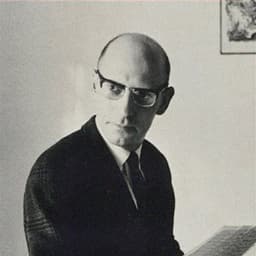
Michel Foucault
He showed that the asylum, the prison, and the clinic are not neutral institutions but machines for defining who counts as normal.
Foucault's method was genealogy: instead of asking what an institution is, ask how it came to be, what historical contingencies shaped the categories we now treat as natural. His history of madness showed that mental illness is a modern category that emerged with the asylum. Discipline and Punish showed that the modern prison was not a humane reform of punishment but a new, more pervasive form of control: and that its logic had spread to schools, hospitals, and factories. His later work on sexuality traced how the discourse of sex became a mechanism of subjectivity: we are not liberated by talking about our desires but produced by talking about them in particular ways. He died of AIDS in 1984, at fifty-seven, having spent his career making the invisible visible: the power that operates not through force but through knowledge, definition, and the production of normal subjects.

Places
Ideas
Words
“Is it surprising that prisons resemble factories, schools, barracks, hospitals, which all resemble prisons?”
“Power is not something that is acquired, seized, or shared. Power is exercised from innumerable points.”
Works
Life & Moments
Chair of the History of Systems of Thought, Collège de France
Elected to the Collège de France in 1969, Foucault held the Chair of the History of Systems of Thought until his death. His inaugural lecture, The Order of Discourse, stated his program: he would study not what people thought but the rules governing what could be said and thought in a given period.
Death in Paris
Foucault died in Paris on June 25, 1984, one of the first prominent French intellectuals to die of AIDS-related illness. He did not publicly disclose his illness. He was working on volumes three and four of The History of Sexuality up to the end; they were published posthumously. He was fifty-seven.
Influence
Influenced by
- Friedrich Nietzsche
Foucault adopted Nietzsche's genealogical method: tracing the origin of values not to reason but to power, conflict, and accident. Where Nietzsche wrote on morality, Foucault applied the method to madness, sexuality, and punishment.
- Jacques Lacan
Lacan and Foucault moved in the same Parisian intellectual circles and shared a broad structuralist suspicion of the unified, self-knowing subject, even as Foucault increasingly distanced his own genealogical method from psychoanalysis's universalizing claims.
Influenced
- Gilles Deleuze
Deleuze and Foucault were close friends and mutual admirers for years before a quiet estrangement over politics; Foucault once said he suspected the whole twentieth century would eventually be called Deleuzian.
- Judith Butler
Butler takes from Foucault the claim that power does not simply repress a subject who was already there but produces subjects, and applies it to gender, where the norm precedes and shapes the person who performs it.


