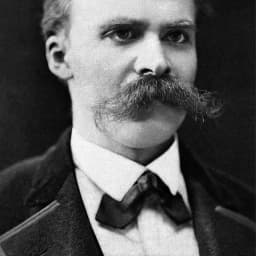
Friedrich Nietzsche
He announced that God was dead and no one had yet understood what that meant. He was right on both counts.
Nietzsche was a classicist who lost his faith in the Greeks, a Wagnerian who lost his faith in Wagner, a Schopenhauerian who lost his faith in pessimism, and a European who announced that God was dead and no one had yet understood what that meant. He wrote in aphorisms because he did not trust systems, in fever because he was almost always ill, and in masks because he was suspicious of any philosophy that pretended to be objective. The will to power is not aggression but the drive to overcome, including oneself. The Übermensch is not a race but a possibility: the human who creates values rather than inheriting them. Eternal recurrence is not a cosmology but a test: can you will your life to repeat, exactly as it was, forever? He collapsed in Turin in 1889, embracing a horse being beaten in the street, and wrote nothing coherent afterward. His sister edited his notes and made him a fascist. He would have been appalled.

Read in the Library
Places
Ideas
Words
“God is dead. God remains dead. And we have killed him.”
“What does not kill me makes me stronger.”
Works
Thus Spoke Zarathustra
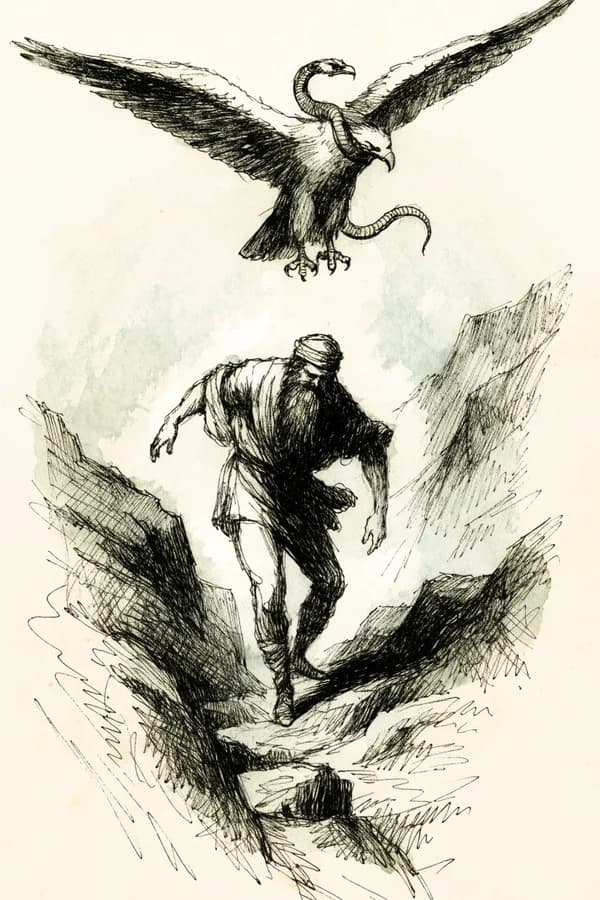
Nietzsche called it a book for everyone and no one. A hermit comes down from the mountains after ten years to tell people that God is dead and that they should make something beyond themselves — and finds that almost nobody wants to hear it. It is written as scripture, and reads as parody and prophecy at once.
Beyond Good and Evil
Nietzsche's assault on the philosophical tradition: dogmatists who mistake their prejudices for truths, Kantians who smuggle in assumptions, utilitarians who reduce everything to comfort. He argues for a new kind of philosopher, a legislator of values who affirms life rather than fleeing from it.
Life & Moments
Thus Spoke Zarathustra
Between 1883 and 1885, Nietzsche wrote the four parts of Zarathustra in a series of inspired sprints. The book announced the death of God, the Übermensch, the eternal return, ideas so compressed in Zarathustra's speeches that their meaning has been disputed ever since. He called it his greatest gift to humanity.
Collapse in Turin
On January 3, 1889, in the Piazza Carlo Alberto in Turin, Nietzsche collapsed after witnessing a horse being flogged. He threw his arms around the animal's neck and lost consciousness. He never recovered. The letters he wrote in his final lucid days were addressed to Bismarck, the king of Italy, and the Pope. His productive life was over.
Influence
Influenced by
- Arthur Schopenhauer
At twenty, Nietzsche read Schopenhauer and recognized a mirror for his own temperament. He spent the next decade moving away: replacing pessimism with affirmation, will-to-denial with will-to-power.
- Fyodor Dostoyevsky
Nietzsche called Dostoyevsky the only psychologist from whom he had learned anything: 'the greatest psychologist of all time.' Notes from Underground's underground man, who asserts his freedom by refusing all rational calculation, prefigures Nietzsche's critique of utilitarian morality.
Influenced
- Martin Heidegger
Heidegger devoted years to interpreting Nietzsche, seeing him as the culmination of Western metaphysics rather than its escape. The death of God was the revelation of nihilism, and overcoming it required rethinking Being from the ground up.
- Michel Foucault
Foucault adopted Nietzsche's genealogical method: tracing the origin of values not to reason but to power, conflict, and accident. Where Nietzsche wrote on morality, Foucault applied the method to madness, sexuality, and punishment.
- Albert Camus
Camus's philosophy of the absurd draws directly on Nietzsche's diagnosis that traditional sources of meaning have collapsed, while resisting Nietzsche's will-to-power alternative in favor of a more modest, lucid persistence.
- Gilles Deleuze
Deleuze's early book Nietzsche and Philosophy reread Nietzsche against the dominant rationalist tradition to build a philosophy privileging difference and becoming over sameness and fixed being, a foundation his entire later work built upon.
- Jacques Lacan
Lacan's account of a self built on a founding misrecognition, rather than a unified, self-transparent consciousness, extends a broadly Nietzschean suspicion of the coherent, sovereign subject that Descartes and later Enlightenment thought had assumed.
- Jacques Derrida
Derrida takes from Nietzsche the suspicion that philosophical concepts are worn metaphors whose figurative origin has been forgotten, and the willingness to treat style as part of the argument.
Engage with Friedrich Nietzsche
Explore structured paths, classic debates, and thought experiments featuring this thinker.
Existentialism
Friedrich Nietzsche is a foremost representative of this school. Test your alignment with this tradition.
Foundations of Ethics: What is the Good Life?
Travel across 2,500 years of ethical philosophy to understand how humanity's greatest minds defined duty, virtue, happiness, and moral duty.
Existentialism: Freedom, Anxiety & Meaning
When pre-packaged meaning collapses, freedom becomes terrifying. Learn how existentialist thinkers turned dread into authentic responsibility.
Kant vs. Nietzsche
Universal Moral Duty vs. The Will to Power: Is morality an objective law or a creative act of will?
Kierkegaard vs. Nietzsche
The Knight of Faith vs. The Antichrist: Should we leap into the divine or overcome God?
Schopenhauer vs. Nietzsche
Cosmic Pessimism vs. Dionysian Affirmation: Should we renounce the Will to Live or embrace it completely?
Nozick's Experience Machine
Do we value experiencing things subjectively, or do we have a fundamental desire to actually BE and DO things in objective reality?


