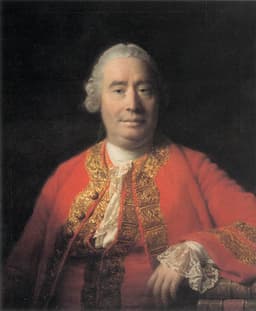
David Hume
The most thoroughgoing skeptic in the history of philosophy. He argued that reason cannot justify itself, causation cannot be proven, and the self is a fiction.
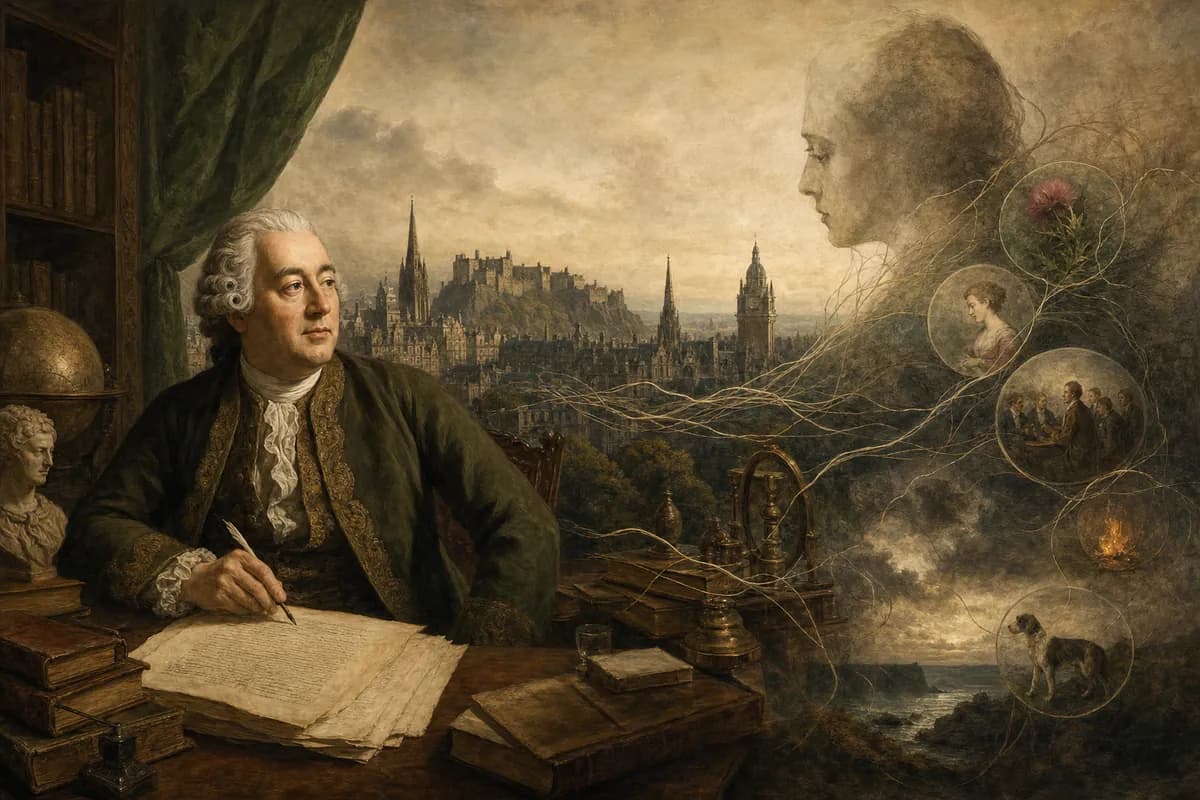
Hume was born in Edinburgh in 1711 and spent his twenties in a frenzy of writing that he later described as nearly driving him mad. The Treatise of Human Nature, published when he was twenty-eight, was the most radical work in the British empirical tradition, taking Locke and Berkeley's principles further than either had dared. He argued that our belief in cause and effect is nothing more than habit, that the self is not a substance but a bundle of passing impressions, and that morality is grounded in sentiment rather than reason. The book fell dead-born from the press, as he later wrote. He spent the rest of his life rewriting the same ideas in more accessible form, working as a librarian and diplomat, writing a bestselling history of England, and becoming the most famous philosopher of his age. He died in 1776, serenely, which his contemporaries found disturbing.

Read in the Library
Places
Ideas
Words
“Reason is, and ought only to be the slave of the passions, and can never pretend to any other office than to serve and obey them.”
“Custom, then, is the great guide of human life.”
“A wise man proportions his belief to the evidence.”
Works
A Treatise of Human Nature
Written when Hume was in his twenties and published in 1739-40. He later called it juvenile, but it is the most radical work in the British empirical tradition: reason is the slave of the passions, the self is a fiction, causation cannot be proven.
An Enquiry Concerning Human Understanding
Published in 1748, a more accessible rewriting of the Treatise's central arguments. The most sustained philosophical examination of knowledge, causation, and miracles written in English.
Dialogues Concerning Natural Religion
Three speakers argue about whether the order of the world proves a designer. Hume withheld the book all his life and arranged for it to appear after his death, which tells you how dangerous he judged it to be. The argument from design has never fully recovered from the questions put to it here.
Life & Moments
Born in Edinburgh
Born in Edinburgh to a modest family of lawyers, he turned inward early and began the work that would unsettle all certainty.
A Treatise of Human Nature
Published in his twenties a book that fell dead-born from the press, yet laid the foundations of modern empiricism and skepticism.
The Paris Salons
Lived in Paris as the rage of the philosophes, welcomed by Rousseau and d'Alembert until the city tired of his calm doubt.
A Cheerful Death
Died in Edinburgh at sixty-five, playing cards and joking with friends, leaving posterity to argue whether he had really been an atheist.
Influence
Influenced by
- John Locke
Hume took Locke's empiricism to its logical conclusion, showing that its principles undermined not only innate ideas but also causation and the self.
- George Berkeley
Hume took up Berkeley's empiricism and followed it past immaterialism into a thoroughgoing skepticism.
- Pierre Bayle
Hume inherited Bayle's doubt about the reach of reason, the claims of religion, and the possibility of certainty.
Influenced
- Adam Smith
Hume and Smith were the closest of the Scottish Enlightenment thinkers. Smith's moral sentiments theory builds directly on Hume's account of sympathy.
- Immanuel Kant
Kant famously said that reading Hume awakened him from his dogmatic slumber. The Critique of Pure Reason is largely an answer to Hume's skepticism about causation.
- Jeremy Bentham
Bentham built his calculus of happiness on the secular, empiricist ground that Hume had cleared.
- John Stuart Mill
Mill worked within and extended the British empiricist tradition that Hume had brought to its crisis. His father James Mill was a Humean utilitarian, and John Stuart absorbed the tradition from childhood.
Engage with David Hume
Explore structured paths, classic debates, and thought experiments featuring this thinker.
Descartes vs. Hume
Rational Cogito vs. Radical Skeptical Empiricism: Can pure reason prove reality without sensory doubt?