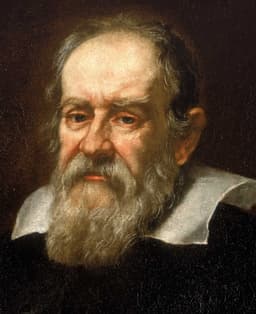
Galileo Galilei
He turned a telescope on the heavens and a mathematician's eye on motion, and was made to kneel for saying the earth moves.
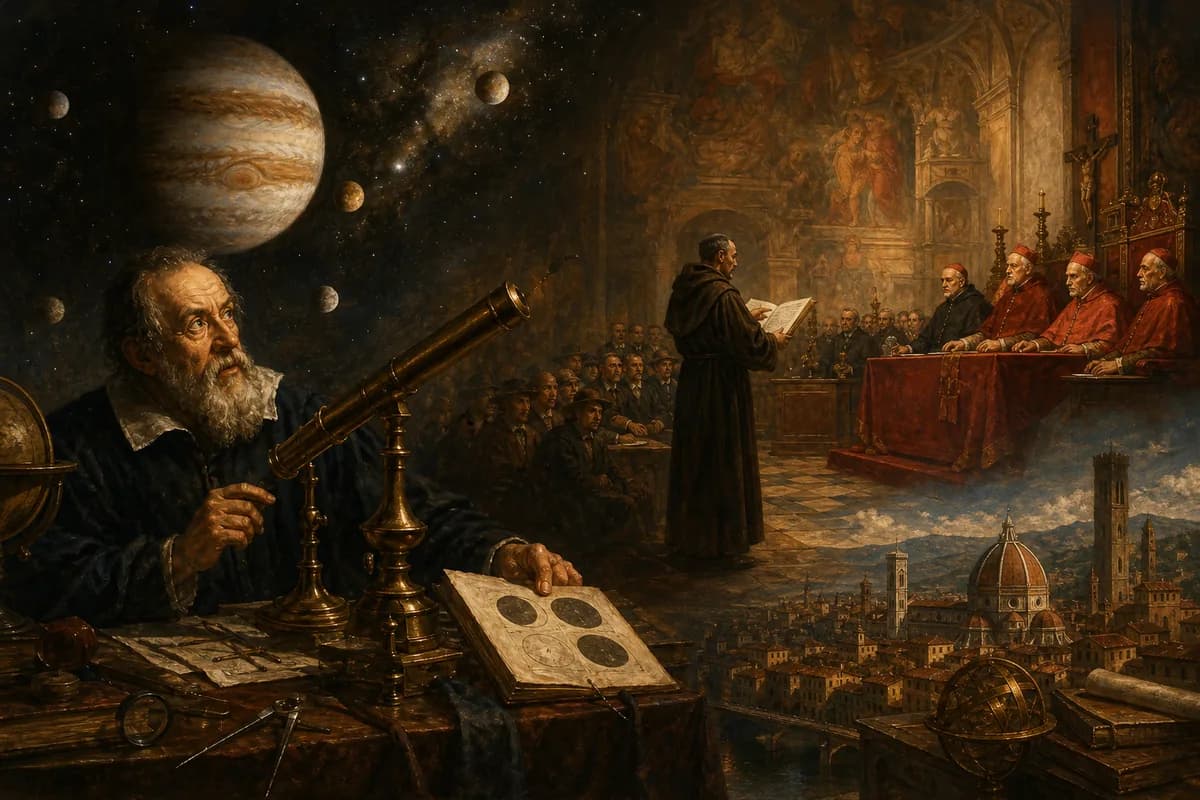
Galileo did more than anyone to make nature speak the language of mathematics. He found that falling bodies obey simple laws, built a telescope and saw mountains on the moon, moons around Jupiter, and the phases of Venus, evidence that the heavens were neither perfect nor turning around us. The book of nature, he wrote, is written in the characters of geometry. His defense of Copernicus brought him before the Inquisition, which forced him to recant and condemned him to house arrest for his last years. The method he modeled (measure, idealize, test) became the engine of modern science.

Places
Ideas
Words
“The book of the universe is written in the language of mathematics, and its characters are triangles, circles, and other geometric figures.”
Works
Life & Moments
Born in Pisa
Born in the Tuscan city of Pisa, he turned early from medicine to mathematics and motion.
The Starry Messenger
Turned a telescope on the heavens and found mountains on the moon and four moons circling Jupiter, evidence the heavens were not perfect.
Dialogue Concerning the Two Chief World Systems
Published his defense of Copernicus in dialogue form, arguing that the book of nature is written in the language of mathematics.
Before the Inquisition
Tried for defending Copernicus, forced to recant that the earth moves, and condemned to house arrest for his last years.
Influence
Influenced by
- Aristotle
Galileo's inclined planes and falling bodies were aimed at the Aristotelian account of motion that the universities still taught, and the Dialogue is organized as a running argument against it.
Influenced
- Thomas Hobbes
Hobbes visited the aging Galileo and modeled his philosophy of bodies in motion on the new mechanical physics.
- Descartes
Descartes had a treatise on the world ready when he learned of Galileo's condemnation in 1633, and withheld it. What he published afterward was shaped by the knowledge of what the Church would tolerate.


