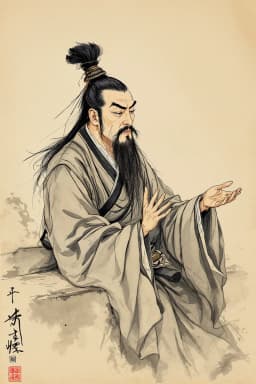
Gongsun Long
A white horse is not a horse. He pushed language until it broke, to see what it was made of.
Gongsun Long belonged to the School of Names, the nearest thing classical China had to formal logic. His most notorious argument claims that a white horse is not a horse, because the term white horse picks out something the term horse does not. Critics called it sophistry; defenders saw a genuine probe into how words, kinds, and things hang together. Working amid the debating halls of the age, he forced his contemporaries to notice that the way we name the world is not the same as the world, a distinction Chinese thought never entirely forgot.

Places
Ideas
Words
“A white horse is not a horse.”
Works
Life & Moments
Born in Zhao
Born in the state of Zhao, he became a leading voice of the School of Names.
Debating at Jixia
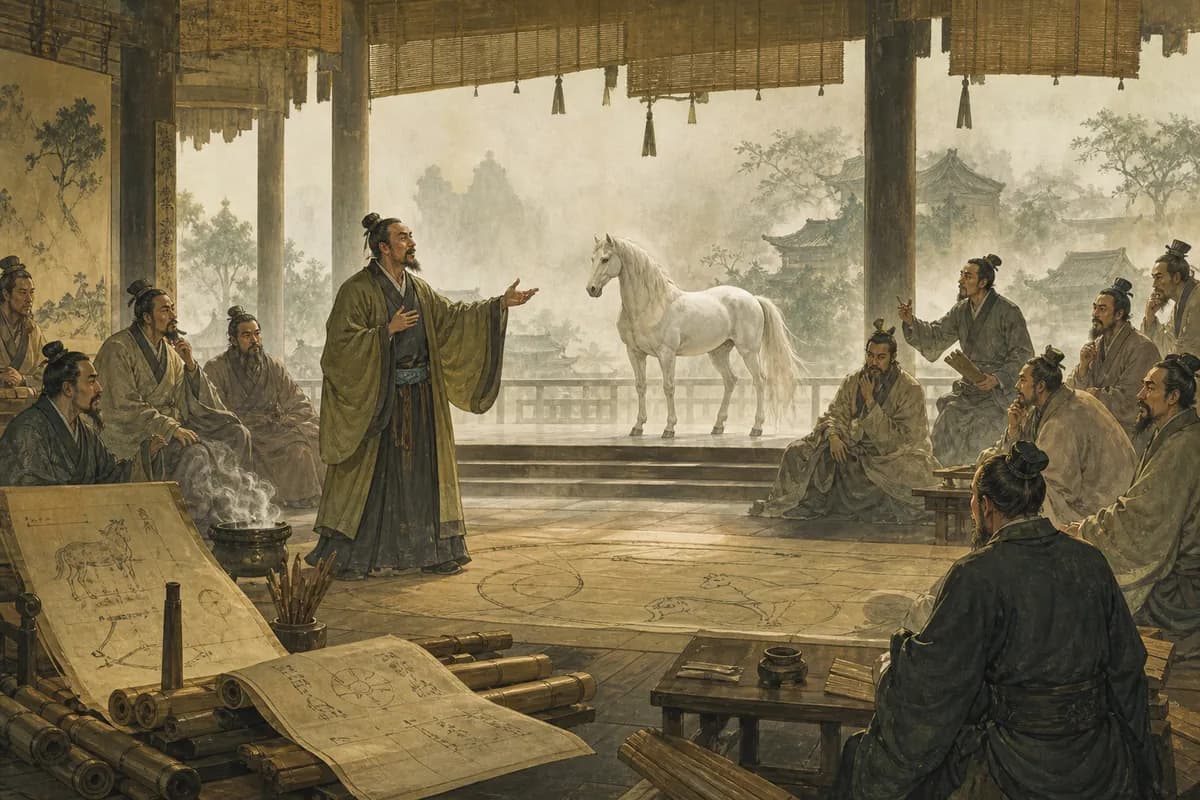
Took part in the great debating halls of the Jixia Academy, forcing rivals to notice that language and reality do not line up neatly.
The White Horse Dialogue
Argued that a white horse is not a horse, probing how names, kinds, and things hang together.
Death
Died after a career of logical provocation. His puzzles kept Chinese thought alert to the gap between names and things.
Influence
Influenced by
- Hui Shi
Hui Shi and Gongsun Long are the two figures the School of Names is remembered by; Gongsun Long pushed the puzzles of reference further, most famously in the argument that a white horse is not a horse.
Influenced
- Zhuangzi
Zhuangzi knew the disputers' arguments well enough to use them and then set them aside, treating the white horse paradox as a demonstration that language cannot be trusted to carve up the world.
- Xunzi
Xunzi's essay on the rectification of names was written partly against Gongsun Long and the disputers, arguing that names are conventions fixed for the sake of order, not puzzles to be broken open.


