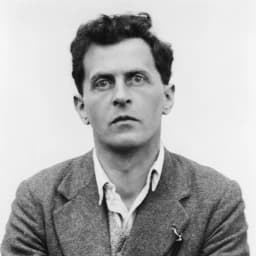
Ludwig Wittgenstein
He wrote two complete philosophies that contradict each other. Both became influential. He disowned the first while writing the second.
Wittgenstein wrote two complete philosophies, and both became influential, and they contradict each other. The Tractatus Logico-Philosophicus argues that language pictures reality: a sentence is a logical picture of a fact, and the limits of language are the limits of the world. Whereof one cannot speak, thereof one must be silent. The Philosophical Investigations, written twenty years later, argues nearly the opposite: meaning is not a private picture but a public practice, a language game embedded in a form of life. Philosophical problems arise when language goes on holiday, when we take words out of the context that gives them meaning. He was born into one of the wealthiest families in Vienna, gave away his inheritance, worked as a gardener and a village schoolteacher and an architect, fought in two wars, and spent most of his philosophical career at Cambridge, where he was Russell's most troublesome student and then the most important philosopher in the room.

Places
Ideas
Words
“Whereof one cannot speak, thereof one must be silent.”
“The limits of my language mean the limits of my world.”
Works
Life & Moments
Tractatus written during the First World War
Wittgenstein served in the Austrian army during the First World War and spent the last months of the war as a prisoner of the Italians. He carried the manuscript of the Tractatus in his rucksack throughout the campaign, completing it in the camp at Cassino. The book appeared in print in 1921.
Returns to philosophy at Cambridge
Convinced he had solved philosophy with the Tractatus, Wittgenstein left academic life and spent years as a schoolteacher in Austrian villages and a monastery gardener. He returned to Cambridge in 1929, submitted the Tractatus as his PhD thesis, and, as he began to see its errors, quietly dismantled everything he had built.
Death in Cambridge
Wittgenstein died in Cambridge in April 1951, of prostate cancer, at the home of his doctor. His last words were reported to be: 'Tell them I've had a wonderful life.' The Philosophical Investigations, the rethinking that had occupied his last two decades, was published posthumously the following year.
Influence
Influenced by
- Bertrand Russell
Russell recognized Wittgenstein's genius from their first meetings at Cambridge and introduced the Tractatus to the English-speaking world. He later found he could not follow where Wittgenstein went next.
Influenced
- Karl Popper
Popper and Wittgenstein occupied opposite poles in Viennese philosophical culture. At their famous Cambridge meeting in 1946, Wittgenstein allegedly brandished a poker. Whether the story is true, they genuinely disagreed about whether philosophical problems are real.
- Saul Kripke
Kripke's short book on Wittgenstein argued that the later Wittgenstein's private language arguments imply a deep skeptical puzzle about what it means to follow a rule correctly, a reading contested by other scholars but influential enough to be nicknamed 'Kripkenstein.'
- John Searle
Searle's speech act theory grew out of the ordinary-language philosophy the later Wittgenstein helped establish at Oxford and Cambridge, treating the meaning of an utterance as inseparable from its use in a form of life.
- Elizabeth Anscombe
Anscombe studied under Wittgenstein at Cambridge during his most demanding late period, became one of his literary executors after his death, and produced the standard English translation of his Philosophical Investigations.
- Richard Rorty
Rorty took the later Wittgenstein's picture of meaning as use within particular language games as evidence that philosophy's traditional hunt for one true vocabulary underlying all others was misguided from the start.
- Kwasi Wiredu
Wiredu learned the analytic habit of asking what a word actually does, then applied it to Twi and found that some standing problems of European philosophy do not survive the translation.
Engage with Ludwig Wittgenstein
Explore structured paths, classic debates, and thought experiments featuring this thinker.
Wittgenstein vs. Russell
The Limits of Language & Mystical Silence vs. Logical Atomism & Scientific Rationalism.


