Place
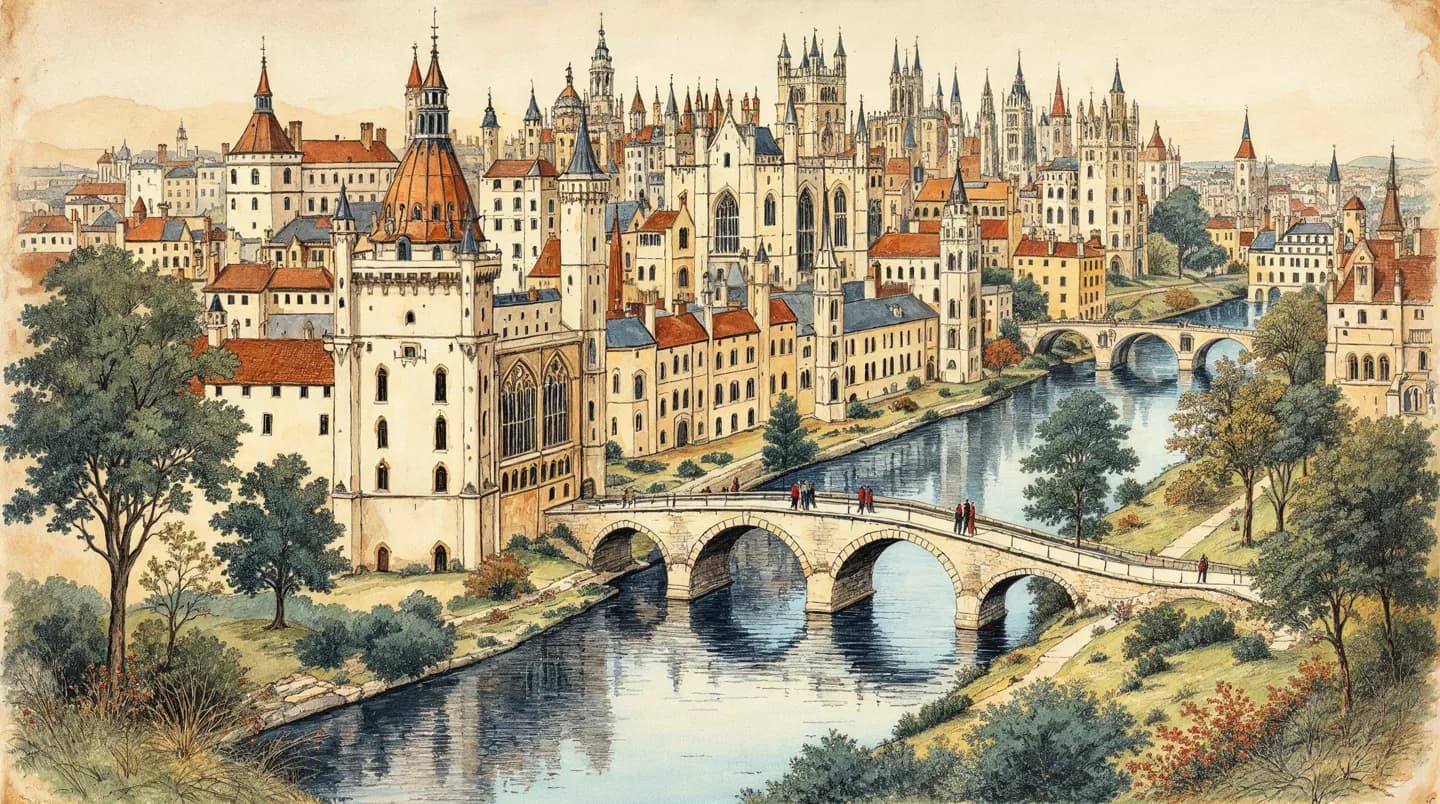
Oxford
A market town on the Thames whose schools grew into one of medieval Europe's foremost universities, with a temper of its own: more mathematical, more empirical, more willing to quarrel with Paris. Roger Bacon lectured here on experiment, Duns Scotus refined distinctions here, and William of Ockham learned the razor-edged logic that made the via moderna.
Oxford's colleges began as halls where masters kept students, and by the thirteenth century the place rivaled Paris. Roger Bacon pressed for observation and mathematics against the temper of his order. Duns Scotus and Ockham both studied here before the quarrels that split late medieval thought. Locke was a student and then a censor of moral philosophy at Christ Church. In the twentieth century the university produced ordinary language philosophy, and Anscombe, Murdoch, Foot, and Midgley studied there together during the war, when most of the men were gone.
Thinkers Connected to Oxford

William of Ockham
Do not multiply entities beyond necessity. His razor cut through centuries of metaphysical overgrowth and cleared the ground for modern science.
Duns Scotus
The Subtle Doctor, who argued that being means the same of God and creatures, and that each thing has its own thisness.

Roger Bacon
The Franciscan who insisted that experiment, not authority, settles a question, and sketched flying machines four centuries early.

Peter Singer
He asked why we don't care about suffering just because it's far away, or caused by an animal. The question has never gone away.

David Chalmers
He named the hard problem of consciousness, why physical processes feel like anything at all, and no one has solved it yet.

Iris Murdoch
She said real love is the very difficult realization that something other than yourself is real, and built an entire moral philosophy on the discipline of truly looking.