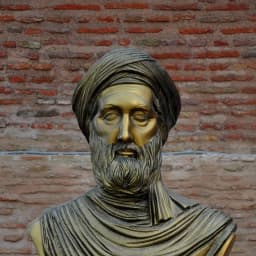
Ibn Khaldun
He watched the Black Death kill his parents and teachers, then spent a turbulent political career gathering evidence for a strikingly modern theory of why civilizations rise, and always, eventually, fall.
Ibn Khaldun was born into a family of scholars and officials in Tunis, and the Black Death that swept through North Africa in his youth, killing both his parents and many of his teachers within the same terrible year, left him one of relatively few survivors of his own intellectual generation. What followed was a genuinely dangerous political career: he served, and was imprisoned by, a rotating cast of sultans and emirs across Muslim Spain and North Africa, surviving court intrigues, shifting alliances, and at least one lengthy stretch in prison, until he eventually withdrew to a fortress in the Algerian countryside for roughly four years specifically to write, having concluded that direct political life left him no time to think about what he had actually witnessed. The result, the Muqaddimah, or Introduction, opens what was meant to be a conventional world history but became something far more original: a theory of history built on the concept of asabiyya, group solidarity or cohesion, which he argued builds in hardy, cooperative frontier and nomadic communities, carries them to conquer and found dynasties, and then dissolves within three or four generations as luxury, individualism, and comfort erode exactly the cohesion that made conquest possible in the first place, a cycle he thought recurred with something close to mathematical regularity across history. Along the way he made strikingly modern observations about labor as the source of economic value, about how excessive taxation can shrink rather than grow a state's revenue, and about the specific vulnerabilities of civilizations that mistake settled comfort for permanent strength. Late in life, serving as a judge in Mamluk Cairo, he was famously lowered by rope over the walls of besieged Damascus to negotiate personally with the conqueror Timur, spending weeks in the presence of a man remaking the map of Asia and recording their conversations as fresh material for the very theory of dynastic rise and collapse he had spent his life developing.

Places
Ideas
Words
“History is a science of a very noble character, deep, subtle, of great utility, and of noble goal.”
“Group feeling produces the ability to defend oneself, to offer opposition, to protect oneself, and to press one's claims. Whoever loses it is too weak to do any of these things.”
Works
Life & Moments
Withdraws to write the Muqaddimah
After years of dangerous political service across North Africa and Muslim Spain, Ibn Khaldun withdrew to a fortress in the Algerian countryside for roughly four years to write, concluding that direct political life left no time to think about what he had witnessed.
Negotiates with Timur outside Damascus
As a judge in Mamluk Cairo, Ibn Khaldun was lowered by rope over the walls of besieged Damascus to negotiate personally with the conqueror Timur, spending weeks recording their conversations as fresh material for his theory of dynastic rise and collapse.
Influence
Influenced by
- Al-Farabi
Ibn Khaldun's account of how cities and dynasties form and decay drew on the tradition of Islamic political philosophy Al-Farabi had established, even as Ibn Khaldun grounded his own theory far more empirically in observed historical cycles.
- Aristotle
Ibn Khaldun accepted Aristotelian logic as a tool and then broke with the tradition that treated politics as a branch of ideal theory, insisting that states be explained by what actually holds groups together.
- Al-Ghazali
Ibn Khaldun shared al-Ghazali's conviction that metaphysics overreaches, and drew from it a different lesson: not that reason should yield to revelation, but that it should be turned on history, where evidence is available.


