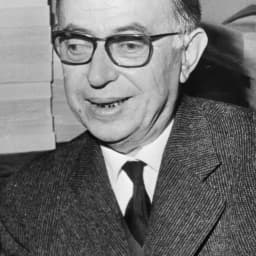
Jean-Paul Sartre
Existence precedes essence. He said it, lived it, and refused the Nobel Prize to prove it.
Sartre's key move was reversing the traditional order: for objects, essence comes first, since a hammer is designed to be a hammer before it exists. For humans there is no blueprint. You exist first, then make yourself what you are. This terrifying freedom, being condemned to be free as he put it, is the foundation of everything else: bad faith (pretending you had no choice), authenticity (owning that you did), and the gaze of the other (the moment someone else's look turns you into a thing). He wrote philosophy, plays, novels, and political journalism in equal torrents. He refused the Nobel Prize in 1964 because he believed it would compromise his independence. He had previously refused the Legion of Honor. He lived in a small Paris apartment, gave most of his money away, and chain-smoked and argued until he could not see. He was wrong about Stalin for too long. He was right about freedom for long enough.

Places
Ideas
Words
“Existence precedes essence.”
“Hell is other people.”
Works
Life & Moments
Being and Nothingness published under occupation
Being and Nothingness appeared in Paris in 1943, while the city was under German occupation. Its seven-hundred-page analysis of freedom and bad faith was immediately recognized as the central work of existentialism. That freedom should be its subject, in occupied Paris, gave the book an urgency that went beyond its argument.
Refuses the Nobel Prize in Literature
In October 1964, Sartre was awarded the Nobel Prize in Literature, and declined it. He gave two reasons: that a writer should not become an institution, and that accepting prizes from the West had political implications he could not endorse while Cold War divisions remained. He was the first person to voluntarily refuse the Nobel Prize.
Influence
Influenced by
- Edmund Husserl
Sartre read Husserl in a Berlin café in 1932 and returned to Paris to make phenomenology existentialist. Consciousness as intentional, always aimed at something beyond itself, became the engine of Sartre's account of freedom.
- Martin Heidegger
Being and Time gave Sartre the vocabulary for Being and Nothingness: facticity and transcendence, authenticity and bad faith. Heidegger later complained that Sartre had humanized, and missed, what Being and Time was about.
- Fyodor Dostoyevsky
Sartre placed Dostoyevsky alongside Kierkegaard as a precursor of existentialism. The underground man's assertion that two plus two may equal five, that human freedom exceeds rational determination, anticipates Sartre's own account of consciousness as that which is not what it is.
- Søren Kierkegaard
Sartre inherited from Kierkegaard the conviction that a human being is not a kind of thing with a nature to fulfil but a freedom that has to choose itself, and stripped it of the faith Kierkegaard thought the point.
Influenced
- Frantz Fanon
Sartre wrote the preface to The Wretched of the Earth, connecting Fanon's analysis to his own account of freedom, authenticity, and the violence of dehumanization. Fanon drew on Sartre's existentialism to articulate colonial subjectivity.
- Maurice Merleau-Ponty
Merleau-Ponty co-founded Les Temps modernes with Sartre and Beauvoir and shared their generation's turn to phenomenology, before breaking with Sartre publicly over the Korean War and the ethics of aligning with Soviet communism.
- Iris Murdoch
Murdoch wrote one of the first English-language studies of Sartre in 1953, then spent the rest of her career arguing against his picture of radical, unconditioned freedom in favor of a Platonic account of goodness as something discovered, not chosen.
- Albert Camus
Camus and Sartre were the two most visible philosophers in postwar France until Camus's The Rebel, with its critique of revolutionary violence aimed at Soviet communism, triggered a bitter public break between them that neither man fully repaired.
Engage with Jean-Paul Sartre
Explore structured paths, classic debates, and thought experiments featuring this thinker.
Existentialism
Jean-Paul Sartre is a foremost representative of this school. Test your alignment with this tradition.
Existentialism: Freedom, Anxiety & Meaning
When pre-packaged meaning collapses, freedom becomes terrifying. Learn how existentialist thinkers turned dread into authentic responsibility.
Camus vs. Sartre
The Absurd Rebel vs. Radical Freedom & Revolutionary Politics: How to live without God in an indifferent universe?


