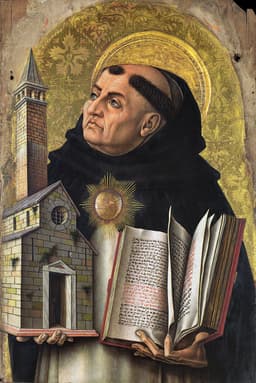
Thomas Aquinas
He reconciled Aristotle with Christianity and wrote the most systematic theology ever attempted. Then he stopped, saying all he had written was straw.
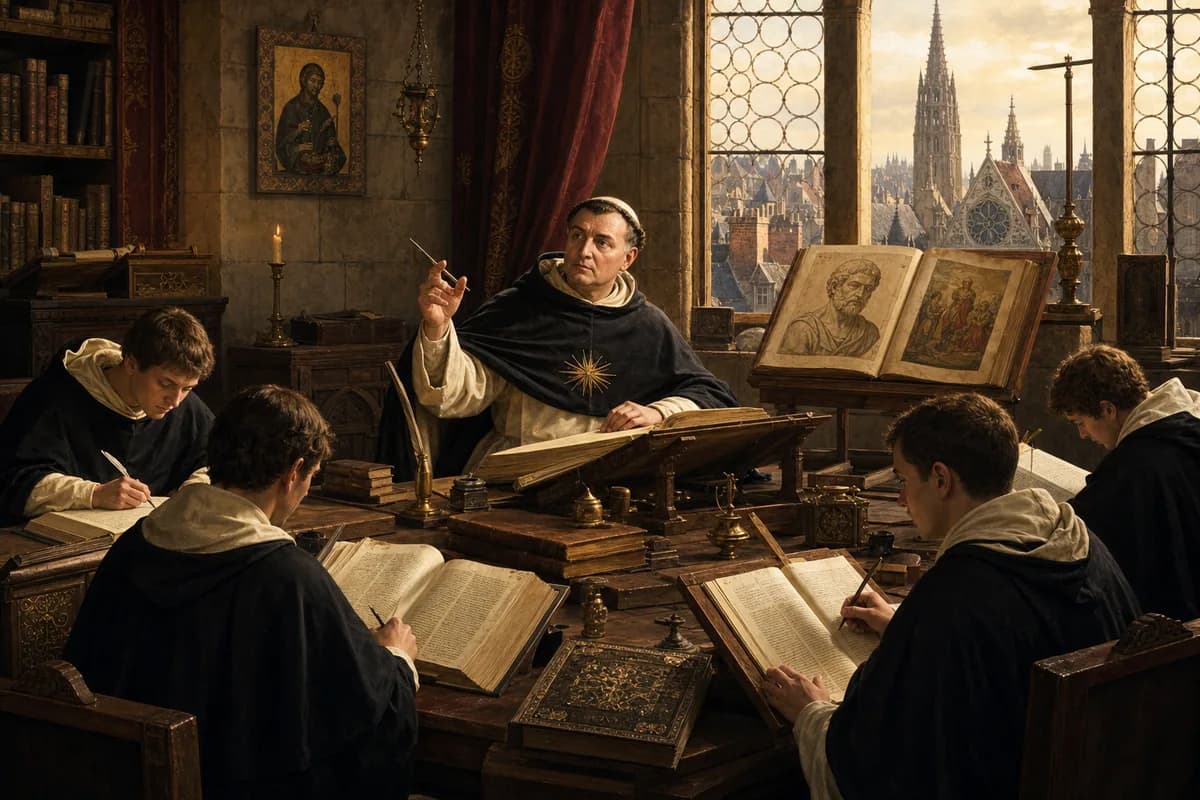
Aquinas was born near Naples, joined the Dominican order against his family's wishes, and studied under Albert the Great in Cologne. He spent his career in Paris and Italy, writing at extraordinary speed, often dictating to four secretaries at once. His Summa Theologica attempts to organize all of Christian doctrine using Aristotelian logic. He developed five proofs of God's existence, a theory of natural law, and a nuanced account of the relationship between faith and reason. Three months before his death, he had a mystical experience during Mass and never wrote again.

Places
Ideas
Words
“To one who has faith, no explanation is necessary. To one without faith, no explanation is possible.”
“The things that we love tell us what we are.”
Works
Life & Moments
Studies in Paris and Cologne
Sent to study at the University of Paris and then under Albert the Great in Cologne. His classmates called him 'the dumb ox' because he was large, quiet, and slow to speak. Albert reportedly said that the bellowing of this ox would one day fill the world.
Writes the Summa Theologica
Began his masterwork, a systematic treatment of nearly every question in Christian theology and philosophy. It runs to millions of words. He structured it as a series of questions, objections, and replies, giving the strongest version of opposing arguments before answering them. He left it unfinished.
The Mystical Experience
While saying Mass in December 1273, Aquinas had an experience he never fully described. He stopped writing and told his secretary: 'Everything I have written seems like straw compared to what has now been revealed to me.' He never wrote another word of philosophy.
Dies on the Road
Died at the Cistercian abbey of Fossanova while traveling to the Council of Lyon. He was forty-nine. The Summa remained unfinished. Within fifty years of his death, his work was recognized as the definitive synthesis of Christian thought and Aristotelian philosophy.
Influence
Influenced by
- Aristotle
Aquinas called Aristotle simply 'The Philosopher' and built the Summa Theologica on Aristotelian logic and metaphysics.
- Ibn Rushd
Aquinas called Ibn Rushd 'The Commentator' and engaged deeply with his Aristotle commentaries throughout the Summa.
- Peter Abelard
Abelard's Sic et Non method of placing authorities in dialogue became the foundation of the scholastic question format Aquinas used.
- Maimonides
Aquinas cites Rabbi Moses often; Maimonides showed the Latin world how Aristotle and scripture might be reconciled.
- Albertus Magnus
Albert taught Aquinas at Cologne and defended his silent student as a voice the whole world would one day hear.
- Boethius
Aquinas took over the definitions Boethius had fixed for terms like person and nature in the theological tractates, which is why a sixth-century Roman senator supplies much of the technical language of thirteenth-century theology.
- Anselm
Aquinas rejected Anselm's proof on the ground that we do not have the kind of grasp of God's essence the argument requires, and built his own case from effects in the world instead.
Influenced
- Duns Scotus
Duns Scotus reacted against Aquinas, arguing that being must be said in one sense of God and creatures alike.
- William of Ockham
Where Aquinas held that the mind grasps a real common nature in things, Ockham argued that only individuals exist and universality belongs to signs alone. That parting of ways defines late medieval philosophy.