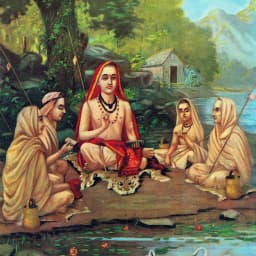
Adi Shankara
In a life scholars now think lasted barely thirty years, he wrote commentaries systematic enough to define Hindu philosophy for the next twelve centuries, all built on one claim: the self and the absolute are not two things.
Shankara's dates are genuinely disputed: the monasteries that trace their lineage to him disagree with each other by over a thousand years, and modern scholarship has mostly settled on the early eighth century, giving him a life so short that its intellectual output looks almost impossible in retrospect. Traditional biographies, more hagiography than history but treasured for what they reveal about how he was remembered, describe a child prodigy in Kerala who mastered the Vedas young, persuaded his widowed mother to let him renounce ordinary life, and then walked the length of India on foot, debating rival schools of thought in public contests with the stakes, in the most famous account, set at nothing less than the loser's whole way of life. His systematic commentaries on the Brahma Sutras, the principal Upanishads, and the Bhagavad Gita built out Advaita, or non-dual, Vedanta into its most influential form: the claim that Atman, the individual self, is not merely similar to but strictly identical with Brahman, the single underlying reality, and that the entire experienced world of separate people, places, and things is maya: not simply illusion in the sense of nothing at all, but a kind of provisional, veiling appearance that dissolves the moment direct knowledge of that underlying identity is realized. He is remembered for a legendary debate with the ritualist scholar Mandana Mishra, judged, according to the story, by Mishra's own formidably learned wife Ubhaya Bharati, who is said to have extended the contest into territory of erotic knowledge Shankara had never studied, sending him off to acquire it by entering the body of a recently deceased king before returning to win. Beyond the legends, his enduring institutional legacy is entirely real: he established monastic centers at the four cardinal points of India, in the south, west, east, and north, each headed by a teacher carrying the title Shankaracharya, and each still functioning today, nearly thirteen centuries after a life some accounts say ended, appropriately for a wandering teacher, in the high Himalayas at Kedarnath rather than anywhere he had ever called home.

Places
Ideas
Words
“Brahman is real; the world is appearance; the individual self is nothing but Brahman.”
“A person is not liberated by mere words, without perceiving the truth; liberation cannot come by any other means than direct realization.”
Works
Life & Moments
Debates Mandana Mishra
In the most celebrated episode of his traditional biography, Shankara debated the ritualist scholar Mandana Mishra in a contest judged by Mishra's own learned wife, Ubhaya Bharati, a story treasured more for what it reveals about his legend than as settled history.
Establishes four monastic centers
Shankara established monastic centers at the four cardinal points of India (south, west, east, and north), each headed by a teacher carrying the title Shankaracharya, and each still functioning today.
Influence
Influenced by
- Badarayana
Shankara's most influential work is a direct commentary on Badarayana's Brahma Sutras, systematizing and extending Badarayana's compressed aphorisms into the full architecture of Advaita Vedanta.
- Kanada
Shankara gives a section of his commentary on the Brahma Sutras to demolishing Vaisheshika atomism, arguing that indivisible particles cannot combine into extended things without contradiction.
- Jaimini
Shankara had to answer Jaimini before he could argue anything else: if scripture's whole purpose is to prescribe action, as Mimamsa held, there is no room for passages that simply state what reality is.
- Dharmakirti
Shankara's arguments against Buddhist idealism are aimed at the position Dharmakirti had made formidable, that awareness is self-illuminating and objects are never given apart from it.
- Patanjali
Advaita found room for yogic discipline as preparation while denying that it could itself produce liberation, since on Shankara's account what liberates is knowledge of what was always already the case.
Influenced
- Ramanuja
Ramanuja's Sri Bhashya was written as a direct, sustained answer to Shankara's Advaita reading of the Brahma Sutras two or three centuries earlier, arguing that Brahman really contains souls and matter rather than standing alone as undifferentiated reality.
- Madhva
Madhva reserved his most direct polemical energy for Shankara's Advaita, arguing at length that treating the world and individual souls as ultimately unreal contradicted both scripture and ordinary experience.
- Rabindranath Tagore
Tagore wrote from a Vedantic inheritance in which the divine is not separate from the world, which is why his poems keep finding the infinite in a particular river, a particular light, a particular child.


