
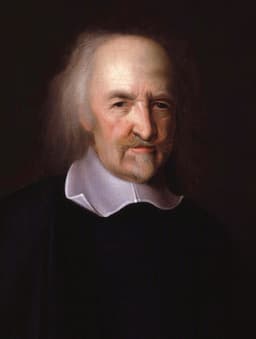
Thomas Hobbes
Without government, life is solitary, poor, nasty, brutish, and short. He built political philosophy on fear.

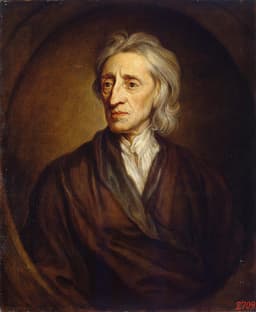
John Locke
The mind begins as a blank slate. All knowledge comes from experience. He wrote the philosophy that launched modern democracy.
“The Leviathan Order vs. Natural Rights: Is human nature brutal or inherently cooperative?”
In the shadow of the bloody English Civil War, Thomas Hobbes and John Locke proposed radically conflicting visions of human nature and political legitimacy. For Hobbes, the state of nature is a horrific 'war of all against all' where human life is 'solitary, poor, nasty, brutish, and short'—escapeable only by surrendering our liberties to an absolute sovereign (Leviathan). John Locke counter-argued that humans in nature are rational and possess natural rights to life, liberty, and estate. Governments exist solely as trustees to protect those rights, and when they fail, the people have a sacred right to revolution.
Head-to-Head Stance Matrix
How both philosophers answered history's most critical questions.
The State of Nature
“What is life like without a government?”
War of All Against All: Bellum omnium contra omnes. Men are driven by fear, competition, and vainglory. Life is nasty, brutish, and short.
State of Equality and Reason: Humans live peacefully under natural moral law, possessing God-given rights to life, health, liberty, and property.
The Social Contract
“Why do individuals form a commonwealth?”
Survival and Peace: Citizens surrender all their rights and weapons to an absolute sovereign in exchange for protection from violent death.
Preservation of Property: Citizens form a government to establish an impartial judge and protect their pre-existing natural rights.
Right to Revolution
“Can the people ever overthrow their sovereign?”
Strictly Forbidden: Anarchy is infinitely worse than any tyranny. To rebel is to plunge society back into the horrors of the state of nature.
Sacred Right: When a ruler breaks the trust and violates natural rights, they enter a state of war with the people, who may rightfully replace them.
Property Rights
“What makes private property legitimate?”
Creation of the Sovereign: Property does not exist in nature. You own only what the laws of the sovereign allow you to own.
Labor Theory of Property: When a person mixes their labor with the earth, it becomes their private property prior to any state.
In Their Own Words
“The life of man, solitary, poor, nasty, brutish, and short.”
— Leviathan (1651)
“Being all equal and independent, no one ought to harm another in his life, health, liberty, or possessions.”
— Second Treatise of Government
How Did They Meet or React?
Hobbes published Leviathan in 1651 during the aftermath of Charles I's execution. Locke published his Two Treatises of Government in 1689 to justify the Glorious Revolution. Locke built on Hobbes' concept of the Social Contract but flipped its conclusion from absolutism to constitutional liberalism.
Where Do They Agree?
Both rejected the Divine Right of Kings, agreeing that legitimate political rule derives entirely from a social contract consented to by individuals rather than God-given royal bloodlines.
Network Connections in the Atlas
Thomas Hobbes → rival on social contract → John Locke — Locke's political philosophy was partly a response to Hobbes: both grounded government in consent, but Locke insisted on natural rights.
SHARED CONCEPTS & IDEAS
SHARED PLACES
Where to Start Reading
Thomas Hobbes
Leviathan (Leviathan)
Chapter XIII is the quintessential formulation of the natural condition of mankind.
John Locke
Second Treatise of Government (Hükümet Üzerine İkinci İnceleme)
Chapters II and V detail natural equality and the labor theory of property.
Frequently Asked Questions
Officially, Locke was refuting Sir Robert Filmer's patriarchal divine right theory, but modern scholars recognize that his real philosophical target throughout the Second Treatise was Hobbes' justification of absolutism.
Curated Head-to-Head Debates
Explore humanity's greatest intellectual clashes with structured 4-pillar analysis and quote duels.


Plato vs. Aristotle
Ideal Forms vs. Empirical Realism: Is truth transcendent or immanent in the physical world?

Kant vs. Nietzsche
Universal Moral Duty vs. The Will to Power: Is morality an objective law or a creative act of will?

Descartes vs. Hume
Rational Cogito vs. Radical Skeptical Empiricism: Can pure reason prove reality without sensory doubt?


Seneca vs. Epictetus
The Imperial Statesman vs. The Freed Slave: How do wealth and servitude test Stoic equanimity?


Laozi vs. Confucius
Spontaneous Nature (Dao) vs. Social Ritual (Li): Should we flow with water or cultivate moral discipline?


Heraclitus vs. Parmenides
Eternal Flux vs. Changeless Being: Does everything change, or is change an illusion?


Epicurus vs. Zeno of Citium
Tranquil Pleasure (Ataraxia) vs. Stoic Duty (Logos): How to achieve tranquility in an uncertain world?


Spinoza vs. Leibniz
Pantheist Necessity vs. The Monadology: Is the universe one deterministic Substance, or an infinity of harmonized monads?


Camus vs. Sartre
The Absurd Rebel vs. Radical Freedom & Revolutionary Politics: How to live without God in an indifferent universe?

Kierkegaard vs. Nietzsche
The Knight of Faith vs. The Antichrist: Should we leap into the divine or overcome God?

Schopenhauer vs. Nietzsche
Cosmic Pessimism vs. Dionysian Affirmation: Should we renounce the Will to Live or embrace it completely?

Marcus Aurelius vs. Seneca
Emperor on Campaign vs. Senator of Rome: The supreme ruler burdened by empire vs. the master of literary counsel.


Socrates vs. Protagoras
Objective Truth vs. Relativism: Is truth discovered through dialectic, or is man the measure of all things?


Rousseau vs. Voltaire
The Noble Savage & General Will vs. Enlightenment Progress & Rational Wit.

Diogenes vs. Plato
Radical Cynic Street Action vs. The Intellectual Academy: Is philosophy lived in a tub or contemplated in abstract forms?


Wittgenstein vs. Russell
The Limits of Language & Mystical Silence vs. Logical Atomism & Scientific Rationalism.


Zhuangzi vs. Xunzi
Wild Spontaneity & Butterfly Dreams vs. Human Nature is Evil & Needs Cultivation.