
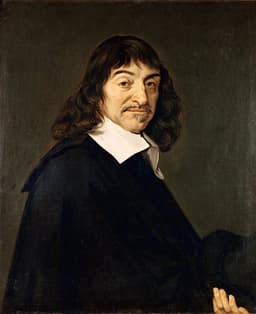
Descartes
I think, therefore I am. He doubted everything until he found one thing he could not doubt: the fact that he was doubting.

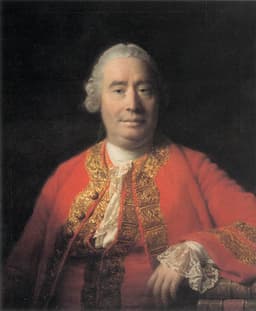
David Hume
The most thoroughgoing skeptic in the history of philosophy. He argued that reason cannot justify itself, causation cannot be proven, and the self is a fiction.
“Rational Cogito vs. Radical Skeptical Empiricism: Can pure reason prove reality without sensory doubt?”
René Descartes sought an unshakable foundation for knowledge by systematically doubting everything until he found the rock-bottom truth: 'I think, therefore I am.' From this pure rational intuition, he attempted to deduce the existence of God and the objective reality of the external world. A century later, David Hume shattered this rationalist dream. Hume demonstrated that neither causation nor the self nor the future can be proven by pure reason: all our convictions rest solely on sensory impressions and psychological habit.
Head-to-Head Stance Matrix
How both philosophers answered history's most critical questions.
The Foundation of Certainty
“What can we be absolutely certain of?”
The Cogito: Even if an evil demon deceives me, the very act of thinking proves beyond all doubt that I exist as a thinking thing.
The Bundle of Impressions: Look inward and you find only a passing stream of perceptions, never an enduring, unified 'I'.
Causality & Physical Laws
“How do we know that causes truly produce effects?”
Rational Necessity: Clear and distinct ideas reveal the mathematical laws established in nature by a benevolent Creator.
Psychological Custom: We only observe constant conjunction (B following A). The idea of 'necessary connection' is an illusion of habit.
The Role of Reason and Emotion
“What should govern human action?”
Sovereignty of Reason: The will must be guided by clear intellectual judgment, conquering the irrational passions.
Slave to the Passions: Reason is, and ought only to be, the slave of the passions, and can never pretend to any other office than to serve them.
Innate Ideas vs Tabula Rasa
“Does the mind possess innate knowledge from birth?”
Innate Ideas: God implants foundational concepts (infinity, geometry, perfection) into the human soul prior to any experience.
Radical Empiricism: No idea exists in the mind that was not first experienced as a sensory impression.
In Their Own Words
“Cogito, ergo sum. (I think, therefore I am.)”
— Discourse on the Method
“Reason is, and ought only to be the slave of the passions.”
— A Treatise of Human Nature
How Did They Meet or React?
Hume composed his masterpiece, A Treatise of Human Nature, while living in France at La Flèche—the very Jesuit college where Descartes had been educated decades earlier. Hume saw himself as the Newton of the moral sciences, replacing Descartes' deductive metaphysics with empirical observation of human psychology.
Where Do They Agree?
Both thinkers made doubt their primary weapon against scholastic dogma, rejected blind faith in medieval authority, and revolutionized philosophy by beginning with the mechanics of the human mind.
Where to Start Reading
Descartes
Meditations on First Philosophy (İlk Felsefe Üzerine Meditasyonlar)
Meditations I and II lay out methodical doubt and the discovery of the Cogito.
David Hume
An Enquiry Concerning Human Understanding (İnsanın Anlama Yetisi Üzerine Bir Soruşturma)
Sections IV and V contain Hume's famous skeptical doubts concerning causation.
Frequently Asked Questions
Because it showed that science does not observe necessity in nature—only that B repeatedly follows A. We cannot logically prove that the sun will rise tomorrow simply because it has risen every day before.
Curated Head-to-Head Debates
Explore humanity's greatest intellectual clashes with structured 4-pillar analysis and quote duels.


Plato vs. Aristotle
Ideal Forms vs. Empirical Realism: Is truth transcendent or immanent in the physical world?

Kant vs. Nietzsche
Universal Moral Duty vs. The Will to Power: Is morality an objective law or a creative act of will?


Seneca vs. Epictetus
The Imperial Statesman vs. The Freed Slave: How do wealth and servitude test Stoic equanimity?


Hobbes vs. Locke
The Leviathan Order vs. Natural Rights: Is human nature brutal or inherently cooperative?


Laozi vs. Confucius
Spontaneous Nature (Dao) vs. Social Ritual (Li): Should we flow with water or cultivate moral discipline?


Heraclitus vs. Parmenides
Eternal Flux vs. Changeless Being: Does everything change, or is change an illusion?


Epicurus vs. Zeno of Citium
Tranquil Pleasure (Ataraxia) vs. Stoic Duty (Logos): How to achieve tranquility in an uncertain world?


Spinoza vs. Leibniz
Pantheist Necessity vs. The Monadology: Is the universe one deterministic Substance, or an infinity of harmonized monads?


Camus vs. Sartre
The Absurd Rebel vs. Radical Freedom & Revolutionary Politics: How to live without God in an indifferent universe?

Kierkegaard vs. Nietzsche
The Knight of Faith vs. The Antichrist: Should we leap into the divine or overcome God?

Schopenhauer vs. Nietzsche
Cosmic Pessimism vs. Dionysian Affirmation: Should we renounce the Will to Live or embrace it completely?

Marcus Aurelius vs. Seneca
Emperor on Campaign vs. Senator of Rome: The supreme ruler burdened by empire vs. the master of literary counsel.


Socrates vs. Protagoras
Objective Truth vs. Relativism: Is truth discovered through dialectic, or is man the measure of all things?


Rousseau vs. Voltaire
The Noble Savage & General Will vs. Enlightenment Progress & Rational Wit.

Diogenes vs. Plato
Radical Cynic Street Action vs. The Intellectual Academy: Is philosophy lived in a tub or contemplated in abstract forms?


Wittgenstein vs. Russell
The Limits of Language & Mystical Silence vs. Logical Atomism & Scientific Rationalism.


Zhuangzi vs. Xunzi
Wild Spontaneity & Butterfly Dreams vs. Human Nature is Evil & Needs Cultivation.