
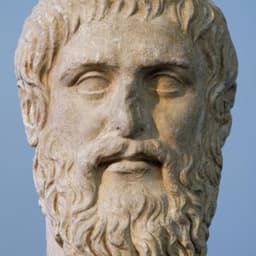
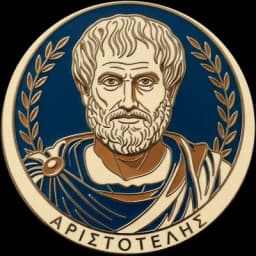
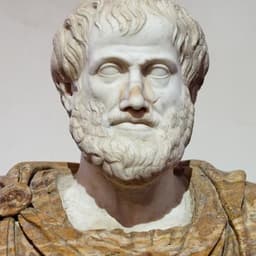
“Ideal Forms vs. Empirical Realism: Is truth transcendent or immanent in the physical world?”
The rupture between Plato and Aristotle is Western philosophy's foundational debate. In Raphael's fresco The School of Athens, Plato points upward to the transcendent world of eternal Forms, while Aristotle gestures forward with open palm toward the earthly realm of observable particulars. Plato argued that physical objects are mere flickering shadows of immaterial ideals; Aristotle replied that essence exists only within matter itself, establishing empirical observation as the foundation of science.
Head-to-Head Stance Matrix
How both philosophers answered history's most critical questions.
The Nature of Reality (Metaphysics)
“Where does the fundamental reality of things reside?”
Dualistic Idealism: The true reality is the non-physical realm of eternal, immutable Forms (eidos). The sensory world is merely a flawed, changing copy.
Hylomorphic Realism: Form and matter are inseparable in individual substances. Reality is right here in existing physical entities, not in an otherworldly realm.
How We Know (Epistemology)
“Is knowledge acquired through pure intellect or sensory observation?”
Anamnesis (Recollection): The immortal soul knew the Forms before birth. Learning is not acquiring new facts, but remembering eternal truths through dialectic.
Empirical Induction: The mind begins as an unwritten tablet. We observe particular instances in nature, detect patterns, and abstract universal principles.
The Good Life (Ethics)
“What is virtue, and how does a human achieve flourishing?”
Virtue as Intellectual Knowledge: To know the Form of the Good is to do the good. Evil is merely ignorance of ultimate truth.
Virtue as Practical Habit (Golden Mean): Moral excellence is cultivated through habit and finding the balance between deficiency and excess.
The State & Justice (Politics)
“What is the just political community?”
Philosopher-Kings: An ideal, strictly stratified republic governed by enlightened rulers who have ascended out of the cave.
The Constitutional Polity: A balanced civic constitution built on the middle class, combining democracy and aristocracy with the rule of law.
In Their Own Words
“The blame is his who chooses; God is blameless.”
— The Republic (617e)
“We are what we repeatedly do. Excellence, then, is not an act, but a habit.”
— Nicomachean Ethics
How Did They Meet or React?
Aristotle arrived at Plato's Academy in Athens as a seventeen-year-old youth from Stagira and studied there for twenty years until Plato's death in 348 BCE. Though Aristotle revered his teacher, declaring that Plato showed how a man could be good and happy at the same time, he famously proclaimed in the Nicomachean Ethics: 'Dear is Plato, but dearer still is truth.' When Plato passed, Aristotle developed his own rival research institution, the Lyceum.
Where Do They Agree?
Despite their metaphysical dispute, both rejected the relativism of the Sophists, argued that the cosmos possesses rational order (Logos), held that virtue is the supreme good for human flourishing (eudaimonia), and believed that political power must be guided by wisdom rather than appetites.
Network Connections in the Atlas
Plato → teacher → student → Aristotle — Aristotle studied at Plato’s Academy for twenty years. He revered Plato but fundamentally disagreed with the theory of Forms.
Where to Start Reading
Plato
The Republic (Devlet)
Read the Allegory of the Cave in Book VII to experience the ascent to the Forms.
Aristotle
Nicomachean Ethics (Nikomakhos'a Etik)
Read Books I & II on eudaimonia and the doctrine of the Golden Mean.
Frequently Asked Questions
Plato believed that true reality consists of immaterial, eternal Forms outside the physical world, which we remember through reason. Aristotle argued that forms exist inside physical things, making empirical observation and taxonomy the foundation of true knowledge.
Curated Head-to-Head Debates
Explore humanity's greatest intellectual clashes with structured 4-pillar analysis and quote duels.

Kant vs. Nietzsche
Universal Moral Duty vs. The Will to Power: Is morality an objective law or a creative act of will?

Descartes vs. Hume
Rational Cogito vs. Radical Skeptical Empiricism: Can pure reason prove reality without sensory doubt?


Seneca vs. Epictetus
The Imperial Statesman vs. The Freed Slave: How do wealth and servitude test Stoic equanimity?


Hobbes vs. Locke
The Leviathan Order vs. Natural Rights: Is human nature brutal or inherently cooperative?


Laozi vs. Confucius
Spontaneous Nature (Dao) vs. Social Ritual (Li): Should we flow with water or cultivate moral discipline?


Heraclitus vs. Parmenides
Eternal Flux vs. Changeless Being: Does everything change, or is change an illusion?


Epicurus vs. Zeno of Citium
Tranquil Pleasure (Ataraxia) vs. Stoic Duty (Logos): How to achieve tranquility in an uncertain world?


Spinoza vs. Leibniz
Pantheist Necessity vs. The Monadology: Is the universe one deterministic Substance, or an infinity of harmonized monads?


Camus vs. Sartre
The Absurd Rebel vs. Radical Freedom & Revolutionary Politics: How to live without God in an indifferent universe?

Kierkegaard vs. Nietzsche
The Knight of Faith vs. The Antichrist: Should we leap into the divine or overcome God?

Schopenhauer vs. Nietzsche
Cosmic Pessimism vs. Dionysian Affirmation: Should we renounce the Will to Live or embrace it completely?

Marcus Aurelius vs. Seneca
Emperor on Campaign vs. Senator of Rome: The supreme ruler burdened by empire vs. the master of literary counsel.


Socrates vs. Protagoras
Objective Truth vs. Relativism: Is truth discovered through dialectic, or is man the measure of all things?


Rousseau vs. Voltaire
The Noble Savage & General Will vs. Enlightenment Progress & Rational Wit.


Diogenes vs. Plato
Radical Cynic Street Action vs. The Intellectual Academy: Is philosophy lived in a tub or contemplated in abstract forms?


Wittgenstein vs. Russell
The Limits of Language & Mystical Silence vs. Logical Atomism & Scientific Rationalism.


Zhuangzi vs. Xunzi
Wild Spontaneity & Butterfly Dreams vs. Human Nature is Evil & Needs Cultivation.