
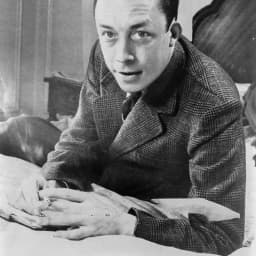
Albert Camus
He argued that the universe offers no meaning and never will, and that the only serious philosophical question left is whether that is a reason to keep living: his answer, against the odds, was yes.

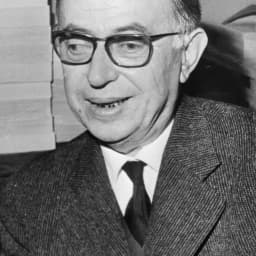
Jean-Paul Sartre
Existence precedes essence. He said it, lived it, and refused the Nobel Prize to prove it.
“The Absurd Rebel vs. Radical Freedom & Revolutionary Politics: How to live without God in an indifferent universe?”
In post-war Paris, Albert Camus and Jean-Paul Sartre were the intellectual rock stars of the left bank. Together they gave voice to an era disillusioned by fascism, war, and the death of traditional certainty. But their friendship dramatically exploded in 1951 over Camus' book The Rebel. Sartre believed that history has a revolutionary direction, justifying political violence and alliance with the Soviet Union to emancipate humanity. Camus passionately rejected ideological murder, arguing that no utopian future justifies totalitarian tyranny in the present.
Head-to-Head Stance Matrix
How both philosophers answered history's most critical questions.
The Absurd vs Freedom
“What is the defining condition of human existence?”
The Absurd: The collision between our deep desire for meaning and the silent, cold universe. One must live courageously with this tension without leap of faith.
Radical Freedom: Humans are condemned to be free. Having no pre-given essence, we define ourselves entirely through our choices, or fall into bad faith.
Violence and Revolution
“Does a noble political end justify violent means?”
Revolt with Limits: No end justifies unjust means. Once you justify terror for tomorrow's paradise, you create eternal hell today.
Engaged Commitment: In an unjust world, neutrality is impossible. Historical progress requires getting one's hands dirty (les mains sales).
In Their Own Words
“One must imagine Sisyphus happy.”
— The Myth of Sisyphus
“Man is condemned to be free; because once thrown into the world, he is responsible for everything he does.”
— Existentialism is a Humanism
How Did They Meet or React?
They met at the premiere of Sartre's play The Flies in 1943 during the Nazi occupation of Paris. Their rupture in 1951-52 played out in the pages of Sartre's journal Les Temps Modernes, becoming the most famous intellectual feud of the 20th century. When Camus died in a car crash in 1960 at age 46, Sartre wrote an extraordinarily moving eulogy, recognizing that Camus represented the moral conscience of their century.
Where Do They Agree?
Both operated on the premise that life has no pre-given divine meaning ('existence precedes essence'), both refused to surrender to nihilism, and both fought in the French Resistance against Nazi oppression.
Network Connections in the Atlas
Jean-Paul Sartre → friendship, rivalry, and public rupture → Albert Camus — Camus and Sartre were the two most visible philosophers in postwar France until Camus's The Rebel, with its critique of revolutionary violence aimed at Soviet communism, triggered a bitter public break between them that neither man fully repaired.
SHARED CONCEPTS & IDEAS
Where to Start Reading
Albert Camus
The Rebel (Başkaldıran İnsan)
The historic essay that caused their final political and personal break.
Jean-Paul Sartre
Existentialism is a Humanism (Varoluşçuluk Bir Hümanizmdir)
The accessible 1945 lecture outlining Sartre's core existentialist tenets.
Frequently Asked Questions
No. Camus explicitly rejected the label in multiple interviews, stating: 'I am not an existentialist. Sartre is an existentialist. The only book of ideas I have published is The Myth of Sisyphus, and it was directed against the existentialist philosophers.'
Curated Head-to-Head Debates
Explore humanity's greatest intellectual clashes with structured 4-pillar analysis and quote duels.


Plato vs. Aristotle
Ideal Forms vs. Empirical Realism: Is truth transcendent or immanent in the physical world?

Kant vs. Nietzsche
Universal Moral Duty vs. The Will to Power: Is morality an objective law or a creative act of will?

Descartes vs. Hume
Rational Cogito vs. Radical Skeptical Empiricism: Can pure reason prove reality without sensory doubt?


Seneca vs. Epictetus
The Imperial Statesman vs. The Freed Slave: How do wealth and servitude test Stoic equanimity?


Hobbes vs. Locke
The Leviathan Order vs. Natural Rights: Is human nature brutal or inherently cooperative?


Laozi vs. Confucius
Spontaneous Nature (Dao) vs. Social Ritual (Li): Should we flow with water or cultivate moral discipline?


Heraclitus vs. Parmenides
Eternal Flux vs. Changeless Being: Does everything change, or is change an illusion?


Epicurus vs. Zeno of Citium
Tranquil Pleasure (Ataraxia) vs. Stoic Duty (Logos): How to achieve tranquility in an uncertain world?


Spinoza vs. Leibniz
Pantheist Necessity vs. The Monadology: Is the universe one deterministic Substance, or an infinity of harmonized monads?

Kierkegaard vs. Nietzsche
The Knight of Faith vs. The Antichrist: Should we leap into the divine or overcome God?

Schopenhauer vs. Nietzsche
Cosmic Pessimism vs. Dionysian Affirmation: Should we renounce the Will to Live or embrace it completely?

Marcus Aurelius vs. Seneca
Emperor on Campaign vs. Senator of Rome: The supreme ruler burdened by empire vs. the master of literary counsel.


Socrates vs. Protagoras
Objective Truth vs. Relativism: Is truth discovered through dialectic, or is man the measure of all things?


Rousseau vs. Voltaire
The Noble Savage & General Will vs. Enlightenment Progress & Rational Wit.

Diogenes vs. Plato
Radical Cynic Street Action vs. The Intellectual Academy: Is philosophy lived in a tub or contemplated in abstract forms?


Wittgenstein vs. Russell
The Limits of Language & Mystical Silence vs. Logical Atomism & Scientific Rationalism.


Zhuangzi vs. Xunzi
Wild Spontaneity & Butterfly Dreams vs. Human Nature is Evil & Needs Cultivation.