
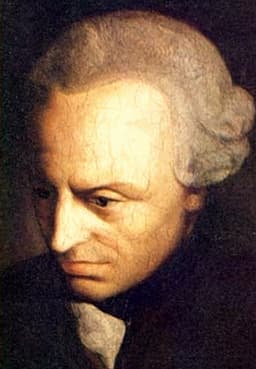
Immanuel Kant
He never left Konigsberg. He remade philosophy. The mind does not simply receive the world; it constructs it. Everything after him is a response.
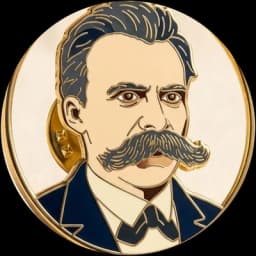
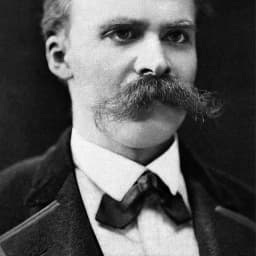
Friedrich Nietzsche
He announced that God was dead and no one had yet understood what that meant. He was right on both counts.
“Universal Moral Duty vs. The Will to Power: Is morality an objective law or a creative act of will?”
Immanuel Kant erected the Enlightenment's grandest monument to moral duty: the Categorical Imperative, which demands that moral rules apply unconditionally and universally to every rational agent. A century later, Friedrich Nietzsche took a hammer to this cathedral. For Nietzsche, universal morality is a mask for 'slave morality'—a resentment-born mechanism designed by the weak to tame the exceptional. Where Kant sought universal laws that restrain egoism, Nietzsche called on free spirits to overcome inherited dogmas and forge their own values.
Head-to-Head Stance Matrix
How both philosophers answered history's most critical questions.
Source of Moral Worth
“Where does moral authority come from?”
Pure Practical Reason: Moral duties are derived from reason alone and apply unconditionally to all rational beings everywhere.
Will to Power & Genealogy: Morals are historical products shaped by power struggles, instincts, and psychological needs.
The Good Person
“Who represents the peak of human flourishing?”
The Dutiful Rational Agent: The person who acts out of reverence for the moral law, never treating others as mere means.
The Übermensch (Overman): The sovereign creator who affirms life, embraces suffering (amor fati), and transvalues all values.
Truth & Reality
“Can we know objective truth?”
Phenomena vs Noumena: We cannot know things-in-themselves, but our shared cognitive faculties establish universal synthetic a priori truths.
Perspectivism: There are no facts, only interpretations. Every claim to objective truth is a drive toward power and dominance.
Suffering and Meaning
“What should be our attitude toward human suffering?”
Moral Dignity: Suffering is a condition of our finite existence; our dignity lies in remaining morally worthy of happiness.
Creative Crucible: Deep suffering is the mother of all human greatness; one must desire to live it infinitely again (Eternal Return).
In Their Own Words
“Two things fill the mind with ever new and increasing admiration: the starry heavens above me and the moral law within me.”
— Critique of Practical Reason
“You have your way. I have my way. As for the right way, the correct way, and the only way, it does not exist.”
— Thus Spoke Zarathustra
How Did They Meet or React?
Nietzsche studied Kant deeply and referred to him throughout his works, alternating between mockingly calling him the 'great chinaman of Königsberg' and recognizing him as the supreme philosophical rival of modernity. While Kant saw himself as securing metaphysics and morality on sound footing, Nietzsche saw Kant as an undercover theologian smuggling Christian pietism through academic jargon.
Where Do They Agree?
Both thinkers agreed that the world-in-itself cannot be known directly through dogmatic traditional religion, and both placed the human subject at the absolute center of value creation, shattering traditional theological authority.
Network Connections in the Atlas
SHARED CONCEPTS & IDEAS
Where to Start Reading
Immanuel Kant
Groundwork of the Metaphysics of Morals (Ahlak Metafiziğinin Temellendirilmesi)
Read Section II to grasp the formulation of the Categorical Imperative.
Friedrich Nietzsche
On the Genealogy of Morality (Ahlakın Soykütüğü Üstüne)
Read Essay I comparing Master Morality to Slave Morality.
Frequently Asked Questions
Nietzsche accused Kant of circular dogmatism: inventing an abstract 'rational duty' that was merely traditional Lutheran Christian morality disguised as universal secular philosophy.
Curated Head-to-Head Debates
Explore humanity's greatest intellectual clashes with structured 4-pillar analysis and quote duels.


Plato vs. Aristotle
Ideal Forms vs. Empirical Realism: Is truth transcendent or immanent in the physical world?

Descartes vs. Hume
Rational Cogito vs. Radical Skeptical Empiricism: Can pure reason prove reality without sensory doubt?


Seneca vs. Epictetus
The Imperial Statesman vs. The Freed Slave: How do wealth and servitude test Stoic equanimity?


Hobbes vs. Locke
The Leviathan Order vs. Natural Rights: Is human nature brutal or inherently cooperative?


Laozi vs. Confucius
Spontaneous Nature (Dao) vs. Social Ritual (Li): Should we flow with water or cultivate moral discipline?


Heraclitus vs. Parmenides
Eternal Flux vs. Changeless Being: Does everything change, or is change an illusion?


Epicurus vs. Zeno of Citium
Tranquil Pleasure (Ataraxia) vs. Stoic Duty (Logos): How to achieve tranquility in an uncertain world?


Spinoza vs. Leibniz
Pantheist Necessity vs. The Monadology: Is the universe one deterministic Substance, or an infinity of harmonized monads?


Camus vs. Sartre
The Absurd Rebel vs. Radical Freedom & Revolutionary Politics: How to live without God in an indifferent universe?


Kierkegaard vs. Nietzsche
The Knight of Faith vs. The Antichrist: Should we leap into the divine or overcome God?

Schopenhauer vs. Nietzsche
Cosmic Pessimism vs. Dionysian Affirmation: Should we renounce the Will to Live or embrace it completely?

Marcus Aurelius vs. Seneca
Emperor on Campaign vs. Senator of Rome: The supreme ruler burdened by empire vs. the master of literary counsel.


Socrates vs. Protagoras
Objective Truth vs. Relativism: Is truth discovered through dialectic, or is man the measure of all things?


Rousseau vs. Voltaire
The Noble Savage & General Will vs. Enlightenment Progress & Rational Wit.

Diogenes vs. Plato
Radical Cynic Street Action vs. The Intellectual Academy: Is philosophy lived in a tub or contemplated in abstract forms?


Wittgenstein vs. Russell
The Limits of Language & Mystical Silence vs. Logical Atomism & Scientific Rationalism.


Zhuangzi vs. Xunzi
Wild Spontaneity & Butterfly Dreams vs. Human Nature is Evil & Needs Cultivation.