Most philosophy syllabi are arranged like museum corridors. You walk past one glass vitrine, spend forty-five minutes inspecting the bust of Plato, take down three bullet points about the Theory of Forms, and then walk into the next alcove to meet Aristotle. The following week brings René Descartes meditating alone beside his winter stove, followed in due course by David Hume playing backgammon in Edinburgh.
The presentation is orderly, respectful, and almost completely misleading.
No genuine philosophical idea was ever hatched in a soundproof room. Thought does not emerge as an isolated monument; it begins as an objection, an interruption, a late-night dispute that spilled onto the pavement. Aristotle was not trying to invent a separate academic department called biology; he had spent twenty years inside Plato’s Academy and was exasperated by the insistence that the world of rocks, horses, and tidal pools was merely a second-rate shadow of immaterial perfection. Immanuel Kant was not scribbling his three Critiques to pass the tenure requirements of Königsberg; he had picked up Hume’s Treatise and realized, with a cold jolt, that if the Scotsman was right about cause and effect, the entire edifice of science was built on sand.
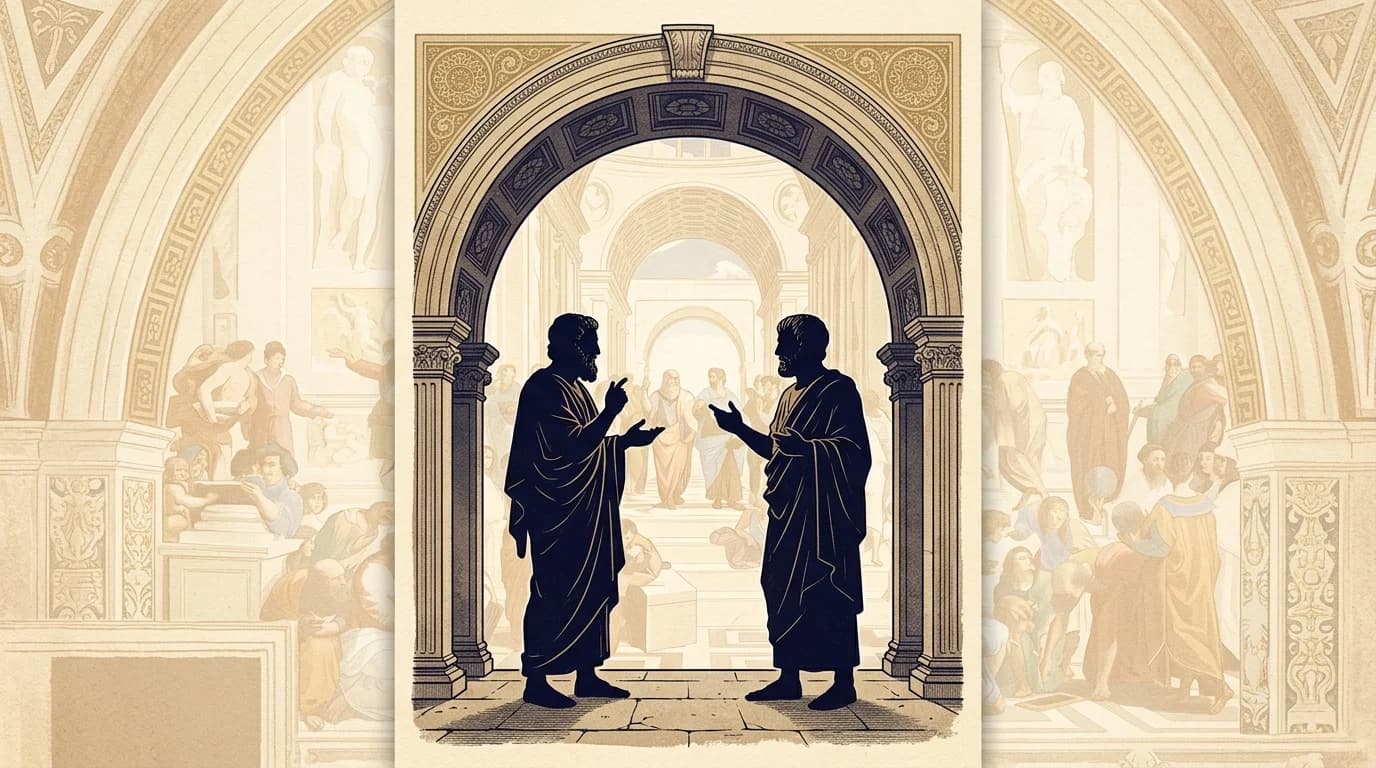
When Raphael painted The School of Athens across the wall of the Apostolic Palace, he understood this instinctively. He did not paint fifty hermits meditating in solitary cells. He placed Plato and Aristotle right in the center, walking stride for stride through a crowded portico, talking with their hands. Plato points upward toward the ceiling, insisting that eternal truth resides in an invisible, transcendent realm. Aristotle holds his open palm horizontally downward, gesturing toward the dirt and the paving stones, insisting that reality is right here, embedded in the tangible particulars we can touch and measure.
Everything Western thought has wondered about science, art, religion, and the state has been a variation on that single gesture.
---
The Flaw of Reading Thinkers Alone
When you read a philosopher in isolation, a peculiar optical illusion occurs: their system feels totalizing.
Read Arthur Schopenhauer on a rainy Sunday, and within sixty pages the universe seems undeniably configured as a blind, ravenous Will that manufactures nothing but suffering. His prose is so clean, his melancholy so persuasive, that it feels almost perverse to disagree. But place Schopenhauer across the table from Friedrich Nietzsche—his most rebellious disciple—and the room changes temperature instantly. Nietzsche looks at the exact same premise (a universe devoid of divine purpose) and draws the opposite conclusion: not ascetic retreat or Buddhist renunciation, but a fierce, dancing affirmation of life, suffering included.
Or take Seneca. Read alone, his letters appear to be the serene counsel of a man who has mastered all circumstance. But place him beside Epictetus, and the social tension becomes unavoidable. Seneca was a billionaire senator advising Nero, writing about detachment from inside a palace furnished with five hundred identical citrus-wood tables. Epictetus was born a slave in Hierapolis, walked with a shattered leg, and owned nothing more than a straw pallet and an iron oil lamp.
Both called themselves Stoics. Both spoke of virtue as the only true good. Yet the way that virtue tasted in the mouth was profoundly different. Seneca’s Stoicism is the philosophy of a statesman trying not to drown in imperial compromise; Epictetus’s Stoicism is the radical survival strategy of someone who owned neither his body nor his legal standing, yet claimed absolute sovereign liberty over his own mind.
You cannot fully understand what Seneca is doing until you see what Epictetus did without. Contrast is not an academic luxury; it is the primary engine of comprehension.
---
Bringing the Arena to Life
This friction is the reason we built the Philosopher Comparison Arena on Atlas of Thinkers.
We wanted a space where philosophy is treated not as a graveyard of dead doctrines, but as a live forum—a place where ideas test their edge against one another. We designed the experience around two complementary approaches: deep curated confrontations and an open, dynamic matchmaker.
1. The Curated Debates
Certain disagreements in intellectual history are so fundamental that they define entire epochs. For these, we created 18 deeply researched, hand-crafted debates across epistemology, ethics, political philosophy, metaphysics, and existentialism.
Each curated confrontation breaks the clash down into its living anatomy:
- The Core Clash: The underlying fracture. Not a Wikipedia summary of two lives, but the precise existential or intellectual dispute that made their coexistence impossible.
- The Historical Dialogue: Did they know each other? Did they exchange polite letters or throw insults? When Diogenes the Cynic heard that Plato had defined man as "a featherless biped," Diogenes plucked a chicken, carried it into Plato's Academy, and announced to the assembled students: "Behold, Plato's man!" When Jean-Paul Sartre and Albert Camus parted ways over the Algerian War and Soviet labor camps, their friendship did not simply fray; their fallout occupied the front pages of Parisian newspapers and marked the moral split of 20th-century Europe.
- The Pillars of Conflict: The dispute broken down into distinct, irreducible battlegrounds—epistemology, human nature, political power, or the meaning of happiness. Under each pillar, both stances are laid side by side, accompanied by a synthesis that shows where the argument leaves us today.
- Shared Ground: The unexpected points of convergence where bitter rivals quietly agree. (Even Thomas Hobbes and John Locke, disagreeing radically on human nature and the social contract, both conceded that political legitimacy derives from the consent of the governed, not divine right.)
- Starter Works: The exact books to read if you want to judge the argument for yourself from primary sources.
2. The Open Dynamic Matchmaker
Philosophy is not limited to historical contemporaries. Some of the most illuminating conversations happen across millennia, languages, and continents.
What happens if you pit Zhuangzi, wandering fourth-century BCE China with his butterfly dreams and delight in the uselessness of old trees, against Ludwig Wittgenstein, pacing his rooms in Cambridge muttering about the bewitchment of our intelligence by language?
In the open arena, you can select any two thinkers in the atlas. The engine dynamically maps:
- Conceptual Intersections: The shared conceptual knots both thinkers wrestled with—whether free will, epistemological doubt, the good life, or political tyranny.
- Lineage and Influence: Who taught whom, who translated whom, and whose ghost was being argued against three hundred years later.
- Geographic Proximity: The shared cities and regions where their ideas took root, from the streets of Athens and Renaissance Florence to the banks of the Seine.
- Direct Voice: Matched quotes from both sides on the same dilemma, accompanied by collectible portrait pins and shareable debate cards that capture the friction at a glance.
---
Three Clashes to Explore First
If you are new to the arena, here are three pairings where the contrast cuts especially deep:
1. Plato vs. Aristotle — The Foundation
Is ultimate truth something transcendent that we recall through intellectual contemplation, or is it immanent in the physical world, uncovered through careful observation and inductive reasoning? This is the root argument beneath the entire history of science and theology.
2. Albert Camus vs. Jean-Paul Sartre — The Moral Fracture
Two young Parisian intellectuals united by resistance to fascism, torn apart by the post-war question: Can violence and terror ever be justified in the name of historical justice? Camus said no; Sartre said history is dirty. A debate whose urgency has never faded.
3. Laozi vs. Confucius — The Flow and the Code
Ancient China’s great civilizational fork. Confucius sought social harmony through rigorous etiquette, ancestral ritual, and cultivated duty. Laozi looked at that same elaborate order and saw an artificial cage, urging a return to wu wei—effortless action aligned with the natural currents of the cosmos.
---
From Disciple to Judge
When you study a single philosopher, you are tempted to become a disciple or a skeptic. You either adopt their vocabulary wholesale or reject them as outdated.
Comparing two thinkers does something healthier: it forces you to become a judge.
You find yourself noticing the unexamined assumptions in both systems. You realize that Plato was brilliant about mathematics but blind to biology; that Aristotle understood natural history but lacked Plato’s sense of poetic wonder; that Camus understood human decency while Sartre understood institutional power.
Philosophy was never intended to be an archive of answers to be memorized for an exam. It is an ongoing argument about how to live, how to think, and how to govern ourselves. The dispute is still open.
Take a seat in the Comparison Arena, choose two minds, and see which one holds the floor.